

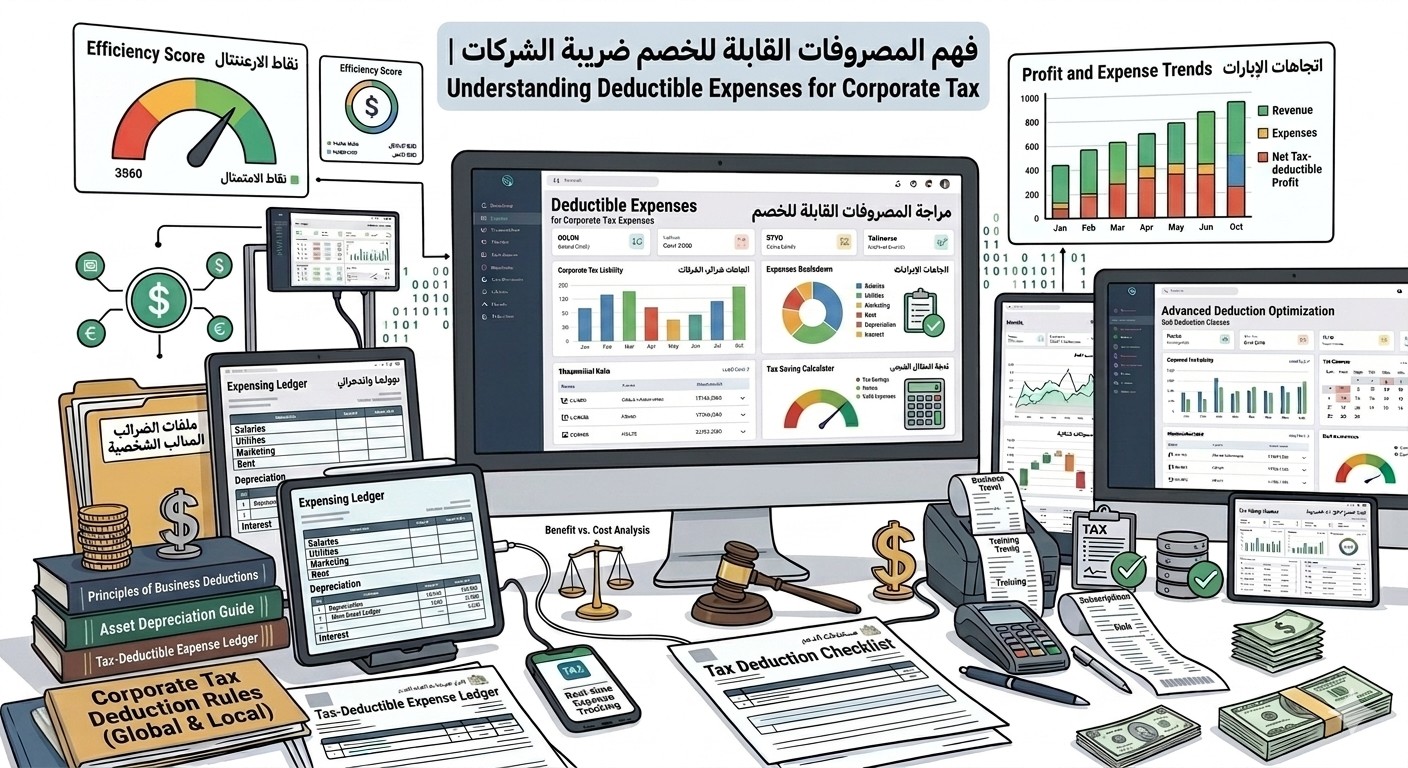
Not every expense recorded in the accounts is automatically deductible for UAE Corporate Tax purposes. Some expenses may be deductible because they are directly connected to the company’s business and taxable income, while other expenses may require adjustment, partial restriction, or full disallowance.
Before filing a Corporate Tax return, expenses should be reviewed to confirm that they are supported by documents, related to the business, separated from personal expenses, and properly assessed where special rules may apply, such as entertainment, interest, penalties, related party transactions, and expenses connected with exempt income.
Al Basma helps companies review expenses before Corporate Tax filing, identify deductible and non-deductible expenses, and prepare the reconciliation between accounting profit and taxable income.
Deductible expenses are expenses incurred by the company for the purpose of carrying on its business and deriving taxable income, provided they are genuine, business-related, supported by documents, and recorded properly in the accounts.
However, tax deductibility does not depend only on the expense title. An expense may look commercial, but it may be unsupported, partly personal, connected with exempt income, or subject to a specific limitation.
For this reason, each major expense category should be reviewed before filing, rather than relying only on the total expense figure in the income statement.
The following expenses may be deductible where they are incurred for business purposes and supported by appropriate documents, subject to any specific limitations or special treatment.
Employee salaries, allowances, insurance, end-of-service benefits, and employment-related benefits where properly recorded and supported.
Office or warehouse rent, electricity, water, telecommunications, internet, and operating costs related to the workplace.
Advertising costs, digital campaigns, design, platform management, promotional materials, and marketing activities related to the company’s business.
Accounting, audit, consulting, legal, technical, and other professional service fees related to the business.
Transport, travel, meetings, and business trip expenses where the business purpose is clear and personal costs are excluded.
Maintenance of assets, equipment, systems, software, and operating expenses necessary for the continuation of the business.
Some expenses should not be accepted automatically in the Corporate Tax return. They should be reviewed to determine whether they are fully deductible, partially deductible, restricted, or non-deductible.
Hospitality, entertainment, meals, and customer meeting expenses require special review because only part of such expenses may be deductible under the applicable rules.
Interest and financing expenses may be subject to special limitations, especially where financing involves related parties or arrangements requiring commercial justification.
Fines, penalties, and violations should not be treated in the same way as normal operating expenses and should be reviewed before filing.
Any personal or dual-purpose expense should be separated or apportioned between the business part and the personal non-deductible part.
Gifts, donations, and contributions require review of the recipient, purpose, and supporting documents, and should not be deducted automatically.
Expenses connected with exempt income may need to be excluded or adjusted when calculating taxable income.
An expense may be correctly recorded for accounting purposes and included in the income statement, but still require an adjustment for Corporate Tax purposes. Accounting aims to present the business result, while Corporate Tax may apply specific rules for accepting, restricting, or disallowing certain items.
Therefore, the review starts from the income statement and trial balance, then identifies expenses that require tax adjustment to move from accounting profit to taxable income.
A clear adjustment schedule helps the company understand the Corporate Tax figure and supports the return in case of any future clarification request or review.
Expenses paid to shareholders, owners, directors, managers, or related companies require special review, especially where they are recorded as salaries, management fees, services, commissions, interest, rent, or shared expenses.
It should be confirmed that these expenses are genuine, documented, business-related, and appropriate in value, and that they do not create an unjustified reduction in taxable income.
The company should also retain documents explaining the relationship, purpose of the expense, calculation method, and contracts or agreements supporting the transaction.
The higher the deductible expenses, the lower the taxable income may become. However, if non-deductible expenses are claimed incorrectly, the taxable income reported in the return may be lower than the correct figure.
For this reason, a clear reconciliation should start from accounting profit, then add back or adjust non-deductible, restricted, or unsupported expenses to arrive at taxable income.
This reconciliation is important not only for calculating tax, but also to show that the company reviewed its expense position before filing.
Al Basma reviews expenses recorded in the accounts and classifies them between deductible expenses, expenses requiring adjustment, and expenses that may be non-deductible or need additional documents.
We help prepare a clear tax adjustment schedule, review supporting documents, separate personal or mixed-purpose expenses, and review sensitive items such as entertainment, interest, fines, and penalties.
We also provide practical recommendations to improve the company’s expense cycle, such as adopting an expense policy, retaining invoices, documenting owner or director expenses, and linking expenses to business activities.
Related Updates and Articles
Carefully selected accredited providers, with pricing and service suited to your business.
Explore the ServiceCall +971506861518
Whatsapp: 00971525886295
EMAIL : info@albasmaa.com


To Know our Services, Don't wait call us or leave your Number in online Chat with time you can received our call and we will call you back or send Email to info@albasmaa.com now.

For join for our team please to send C.V. for Waleed@albasmaa.com