

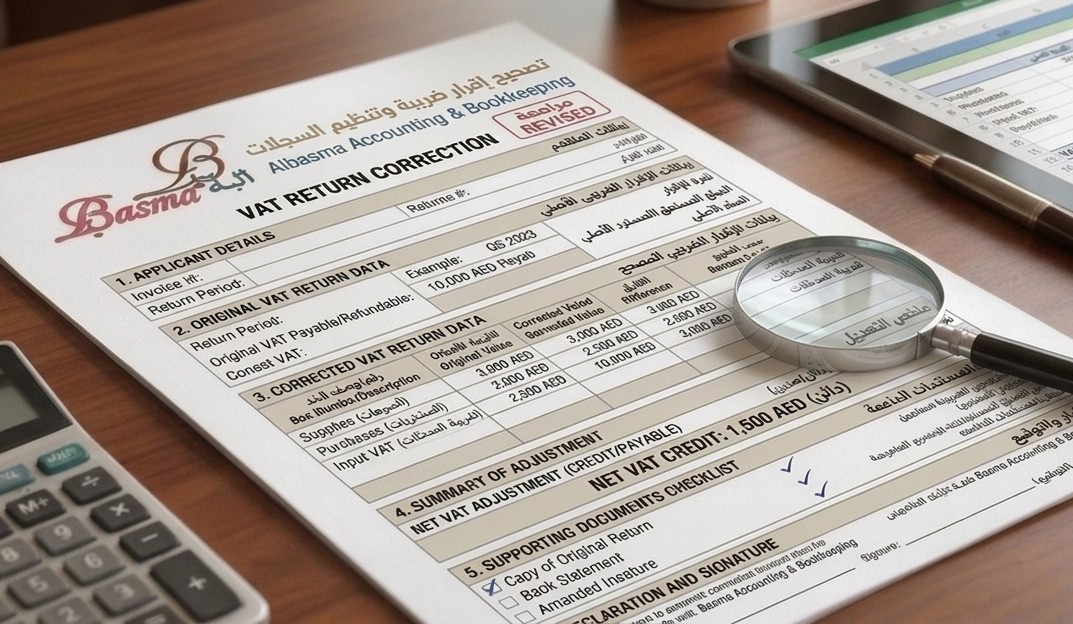
A company may discover after filing a VAT return that a sales invoice was not reported, a purchase invoice was entered incorrectly, input tax was claimed without sufficient supporting documents, or supplies were classified incorrectly as taxable, zero-rated, exempt, or outside the scope of VAT.
Correcting a VAT error is not only a matter of changing figures inside the accounting software. Once the VAT return has already been filed, the company should identify the nature of the error, the affected tax period, the affected return boxes, and the proper correction approach.
Al Basma helps you review the error, prepare a difference schedule, link the correction to invoices and supporting documents, and determine whether the matter requires a voluntary disclosure or can be handled in the relevant VAT return depending on the case.
A company may need to review or correct a VAT return when it discovers that a previously filed return does not reflect the correct sales, purchases, output tax, input tax, or net VAT payable.
The error may be a simple invoice classification issue, a material tax difference, or a repeated error across more than one tax period. Therefore, not every VAT error should be handled in the same way.
Examples include missing sales invoices, reporting sales under the wrong emirate, confusing taxable, zero-rated, exempt, or outside-scope supplies, or missing credit notes.
Examples include claiming input tax on an incomplete invoice, entering an invoice in the wrong tax period, or recording the VAT amount incorrectly.
Examples include relying on a proforma invoice, quotation, invoice without TRN, or invoice that does not clearly show the VAT amount.
Examples include mismatches between customs records and the VAT return, insufficient export evidence, or incorrect treatment of import VAT.
An invoice or credit note may be recorded in the wrong tax period, creating differences between accounting records and the submitted VAT return.
Examples include calculating VAT incorrectly on a VAT-inclusive amount, using the wrong VAT rate, or making a total calculation error in the return.
Before submitting any correction or voluntary disclosure, the company should prepare a clear file explaining what happened, which tax period was affected, and the financial and VAT impact of the error.
A voluntary disclosure is a process used when a registrant discovers an error in a previously submitted tax return or tax assessment and needs to notify the Federal Tax Authority through a specific correction form.
When preparing a voluntary disclosure, the figures previously submitted are compared with the corrected figures. The corrected figures should represent the full correct value for each affected return box, not only the amount of the error.
A letter and supporting documents should also be prepared to explain the background of the error, the reason for the disclosure, the correction method, and the effect of the error on the VAT return boxes.
We review issued and received invoices and check key VAT details such as TRN, date, description, VAT amount, and total amount.
We match credit notes with original invoices and check the reason for issuance and their effect on sales, purchases, and VAT.
We review account movements and bank statements and connect them to sales and purchases, especially where unrecorded or unmatched amounts exist.
We review import records, customs documents, and import VAT entries to confirm their correct reflection in the VAT return.
We review export documents, shipping records, and evidence of goods leaving the UAE where zero-rated supplies or overseas sales are reported.
We compare previous VAT returns with accounting records and trace the boxes that may require correction or reclassification.
Some errors are accounting errors only, such as recording an expense under the wrong account without changing the VAT amount. Other errors are tax errors that affect output tax, input tax, or net VAT payable.
A voluntary disclosure should not be submitted only because there is an internal accounting classification error that does not change the VAT return. At the same time, an internal accounting entry is not enough where the error has already affected a filed VAT return.
Al Basma first reviews the nature of the error, then determines whether it requires accounting correction only, VAT correction, voluntary disclosure, or a change in the method used for future VAT return preparation.
Al Basma reviews the submitted VAT return and compares it with accounting records, invoices, and supporting documents. We then prepare a clear schedule of errors, differences, and affected VAT return boxes.
We also help prepare the correction or voluntary disclosure file, including the reason for the error, the affected tax period, the corrected figures, and the documents supporting the correction.
We can also help improve invoice issuance, purchase recording, credit note review, and VAT settings inside the accounting software to reduce repeated errors in future VAT returns.
Related Updates and Articles
Carefully selected accredited providers, with pricing and service suited to your business.
Explore the ServiceCall +971506861518
Whatsapp: 00971525886295
EMAIL : info@albasmaa.com


To Know our Services, Don't wait call us or leave your Number in online Chat with time you can received our call and we will call you back or send Email to info@albasmaa.com now.

For join for our team please to send C.V. for Waleed@albasmaa.com