عربي
Home Accounting Accounting & BookKeeping Auditing UAE TAX Consultant Report Business Support Governance & Compliance Updated & News About Us


Real Estate Companies Accounting in UAE

Real Estate Companies Accounting in UAE

Are Your Real Estate Accounts Clear?

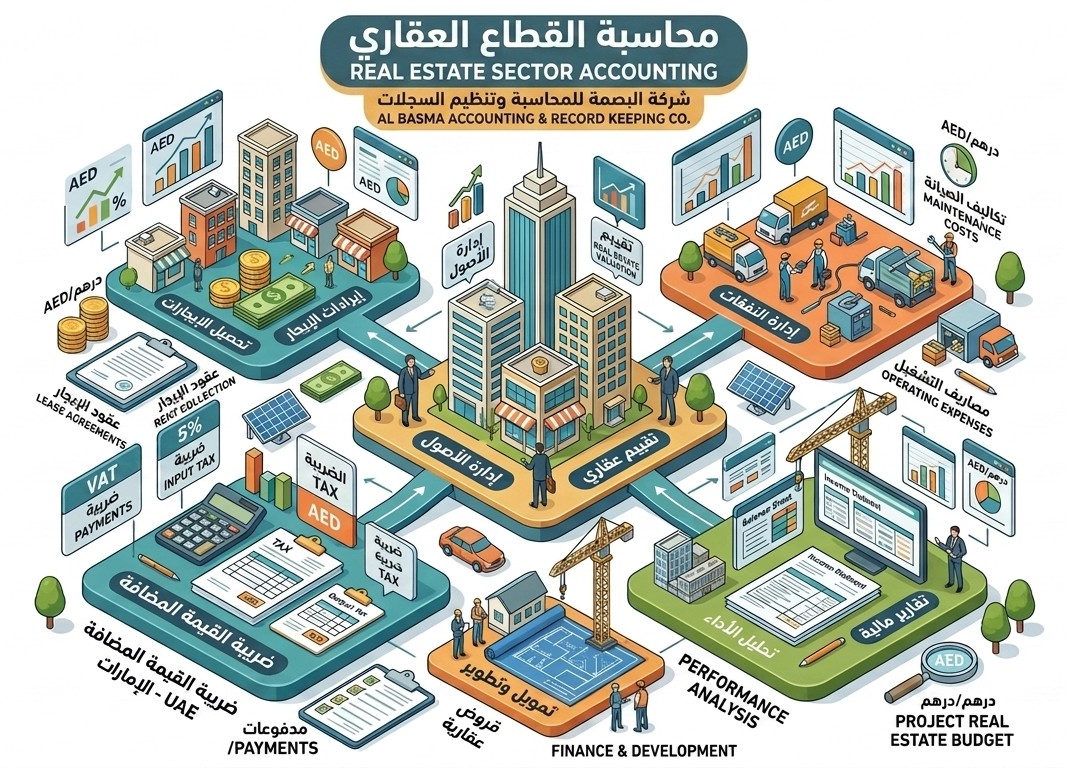
Real estate companies need accounting that is different from ordinary trading activities, because transactions may include property sales, rentals, brokerage commissions, property management fees, advance payments, deposits, maintenance expenses, owner balances, and tenant or buyer balances.

VAT in real estate also requires careful review because the treatment differs between residential property, commercial property, and mixed-use property, as well as between sale, lease, real estate services, and commissions.

Al Basma helps real estate companies, brokerage firms, and property management businesses organize accounts, prepare financial reports, review VAT and Corporate Tax, and prepare a clear file for management, partners, auditors, or relevant authorities.

Real estate accounting is not only about recording rent or commission. Each contract, invoice, receipt, and expense should be connected to the correct property, customer, owner, and tax period.

Why Do Real Estate Companies Need Specialized Accounting?

Real estate activity involves long-term transactions, large amounts, and multiple parties. A company may deal with a developer, owner, tenant, buyer, broker, property manager, maintenance contractor, finance provider, or regulatory authority, and each party may have different balances and documents.

An error in recording a lease contract, commission, or advance payment may affect revenue, VAT, Corporate Tax, customer balances, or reports submitted to partners and property owners.

The accounting system should therefore be able to track the property or unit, income type, period of entitlement, invoices, receipts, expenses, and taxes related to each transaction.

In real estate, the key question is not only how much was collected, but why it was collected, for which unit, for which period, and who owns the balance.

Types of Real Estate Businesses We Serve

Property Management Companies

Organizing rental income, collections, expenses, maintenance, owner balances, and tenant balances.

Real Estate Brokerage Firms

Recording sale and rental commissions, commission invoices, client collections, marketing expenses, and broker accounts.

Property Owners

Preparing accounts for rented properties, income, expenses, maintenance, returns, and reports required by owners or partners.

Real Estate Developers

Tracking buyer installments, project costs, expenses, contracts, units, revenue, and project financial reports.

Maintenance and Property Services

Organizing maintenance invoices, shared expenses, service charges, supplier contracts, and expense allocation to units or owners.

Jointly Owned Properties

Reviewing shared accounts between owners or partners, allocation of income and expenses, and profit or return reports.

Revenue in Real Estate Companies

Real estate revenue is not always one single type. A company may have rent, brokerage commissions, property management fees, unit sales, service charges, amounts recovered from tenants or owners, or income from additional services.

Each revenue type needs correct recording, proper invoicing, and correct tax treatment, especially where residential, commercial, or mixed-use properties are involved.

  • Residential or commercial rental income.
  • Brokerage commissions on sale or rent transactions.
  • Property management or portfolio management fees.
  • Income from sale of units or properties.
  • Service charges and shared maintenance charges.
  • Amounts recovered from owners or tenants.
  • Late payment, cancellation, or additional service fees.
  • Other income connected with the property or project.

VAT in Real Estate Activities

VAT is one of the most important review areas for real estate companies, because the treatment depends on the type of property and the type of supply. Commercial property differs from residential property, sale differs from rent, and real estate services differ from the sale of the property itself.

Mixed-use properties also require separation between residential and commercial parts, and input tax may need to be apportioned between taxable and exempt activities so that the company does not recover VAT that it is not entitled to recover.

For this reason, rental invoices, commission invoices, service invoices, maintenance costs, and other expenses should be reviewed and linked to the property type, customer type, and correct tax period.

Commercial Properties

Commercial property sale or rental requires VAT review, tax invoices, and review of input tax related to the property.

Residential Properties

Residential properties may be exempt or zero-rated in specific cases, so the nature and timing of the supply should be reviewed.

Mixed-Use Properties

Properties containing both residential and commercial parts need clear allocation of income, expenses, and input tax.

In real estate, invoices should not all be treated the same way. The property type and supply type are the basis for determining VAT.

Real Estate Invoices and Documents

Real estate companies need an organized document file for each property, unit, or project. Relying only on bank statements is not enough because bank collections do not always explain the nature of the amount, the period, the unit, or the customer.

Each amount should be linked to a contract, invoice, receipt, collection schedule, or document supporting the accounting and tax treatment.

  • Lease, sale, and property management contracts.
  • Rental, commission, or service invoices.
  • Receipts and bank transfer records.
  • Tenant, owner, and buyer schedules.
  • Unit, property, and project schedules.
  • Maintenance, service, and utility invoices.
  • Supplier, contractor, and service provider contracts.
  • Documents for deposits, guarantees, or advance payments.
  • Credit notes, settlements, or discounts.
  • Reports from property management platforms or systems, where available.

Owner, Tenant, and Customer Balances

One of the most common issues in real estate accounting is the lack of clarity in owner, tenant, or buyer balances. Amounts may be collected without clearly identifying whether they relate to rent, deposit, commission, service charges, advance payments, or refundable amounts.

Detailed accounts or schedules should therefore be maintained by customer, owner, or unit so that the company can identify amounts due, collected, overdue, and settled for each party.

These schedules help management follow up collections, help owners understand property returns, and help the accountant prepare VAT returns, Corporate Tax files, and financial reports.

Expenses in Real Estate Activities

Real estate expenses need careful classification because some expenses relate directly to a property, some relate to general administration, some belong to the owner, and some should be recharged to the tenant or project.

It is also important to review whether expenses are connected with taxable or exempt VAT supplies, because this affects input tax recovery.

  • Maintenance and repairs.
  • Service charges and utilities.
  • Broker and marketing commissions.
  • Real estate advertising and marketing.
  • Management and leasing fees.
  • Legal and consulting fees.
  • Registration or government service fees, depending on the transaction.
  • Employee and administration costs.
  • Finance or property loan expenses, where applicable.
  • Shared expenses across more than one property or project.

Steps to Organize Real Estate Accounts

  • Identify the activity type: brokerage, property management, leasing, development, or sale.
  • Set up a chart of accounts suitable for properties, units, owners, and customers.
  • Create detailed schedules for properties, projects, or units.
  • Link contracts with invoices, collections, and expenses.
  • Separate revenue by type: rent, commission, management, services, and sale.
  • Review VAT based on property type and supply type.
  • Classify expenses by property, project, or general administration.
  • Review owner, tenant, buyer, and supplier balances.
  • Reconcile bank accounts with collections and payments.
  • Prepare monthly reports for revenue, expenses, and balances.
  • Review Corporate Tax and taxable income.
  • Prepare an accounting and tax file supporting returns and reports.

Common Mistakes in Real Estate Accounting

  • Recording all collections as revenue without separating deposits or advance payments.
  • Not linking each collection to the correct property, unit, or contract.
  • Mixing owner income with the income of the management or brokerage company.
  • Not issuing proper invoices for commissions or real estate services.
  • Applying the same VAT treatment to residential and commercial properties.
  • Recovering input tax connected with exempt supplies without proper review.
  • Not allocating shared expenses between properties or units.
  • Not following up tenant, owner, or buyer balances.
  • Recording owner expenses as company expenses without clear separation.
  • Not reconciling bank transactions with lease contracts or collection schedules.
  • Not preparing monthly reports showing income by property or project.
  • Filing VAT or Corporate Tax returns without reviewing contracts and invoices.

The most serious mistake in real estate accounting is mixing company funds with owner, tenant, or buyer funds without clear detailed schedules.

Financial Reports Needed by Real Estate Companies

Real estate reports should help management make decisions, not only show the company’s overall profit. For this reason, we prepare reports by property, project, unit, or customer depending on the nature of the activity.

  • Rental income report by property or unit.
  • Commission income accrued and collected report.
  • Tenant, owner, and buyer balance report.
  • Expense report by property or project.
  • Collections and overdue amounts report.
  • VAT report by property type or supply type.
  • Profitability report by property or project.
  • Advance payment, deposit, and guarantee report.
  • Supplier and contractor balance report.
  • Corporate Tax and taxable income report.

Corporate Tax for Real Estate Companies

Real estate companies also need Corporate Tax review, especially where there are profits from rentals, commissions, property sales, or property management activities.

Revenue, expenses, assets, financing, related party transactions, shared expenses, and any tax adjustments should be reviewed before filing the Corporate Tax return.

It is also important to distinguish between real estate income earned by a company as a business and personal real estate investment income of individuals, because the treatment may differ depending on the person, activity, and supporting documents.

Who Needs This Service?

  • Real estate brokerage companies.
  • Property management companies.
  • Companies managing properties for third parties.
  • Property owners needing organized financial reports.
  • Small and medium real estate developers.
  • Companies with commercial, residential, or mixed-use properties.
  • Companies with real estate VAT issues.
  • Companies needing to organize owner, tenant, and buyer balances.
  • Companies needing reports for partners or investors.
  • Companies preparing for Corporate Tax filing or audit.

How Can Al Basma Help with Real Estate Accounting?

Al Basma reviews the real estate company’s accounting system, organizes the chart of accounts, and links properties, units, and contracts with invoices, collections, and expenses.

We help prepare owner, tenant, and buyer schedules, reconcile bank accounts, review VAT, and classify revenue and expenses according to the nature of the property or activity.

We also prepare monthly or periodic reports for management and partners and help prepare Corporate Tax files, financial statements, and reports required by auditors or relevant authorities.

Services Related to Real Estate Accounting

Why Choose Al Basma for Your Real Estate Accounts?

  • Organize accounts by property, unit, or project.
  • Separate company income from owner or customer funds.
  • Review VAT according to property type and supply type.
  • Prepare clear reports for management and partners.
  • Reconcile collections, banks, contracts, and invoices.
  • Prepare Corporate Tax files and financial statements.

Important Notice: The information provided on this page is intended for general informational purposes only and does not constitute legal, tax, accounting, or professional advice. It should not be relied upon as a substitute for reviewing the applicable laws, regulations, decisions, and official guidance issued by the competent authorities in the United Arab Emirates.

The appropriate legal, tax, or accounting treatment may vary depending on the specific facts and circumstances of each case.

If you require professional advice or assistance relating to your particular situation, please contact us and our team will be pleased to review your case and provide appropriate support.


Related Updates and Articles

site menu

Al Basma Accounting & Bookkeeping provides accounting, audit, taxation, financial advisory, expert reporting, and company formation services in the United Arab Emirates.
Al Basma is also an FTA Approved Tax Agency providing VAT, Corporate Tax, and Tax Compliance services in accordance with UAE tax regulations.

Our Services

```
Al Basma Services

Contacts

Call  +971506861518

Whatsapp: 00971525886295

EMAIL : info@albasmaa.com

Financial Solutions


Corporate Tax

To Know our Services, Don't wait call us or leave your Number in online Chat with time you can received our call and we will call you back or send Email to info@albasmaa.com  now.

For join for our team please to send C.V. for Waleed@albasmaa.com