

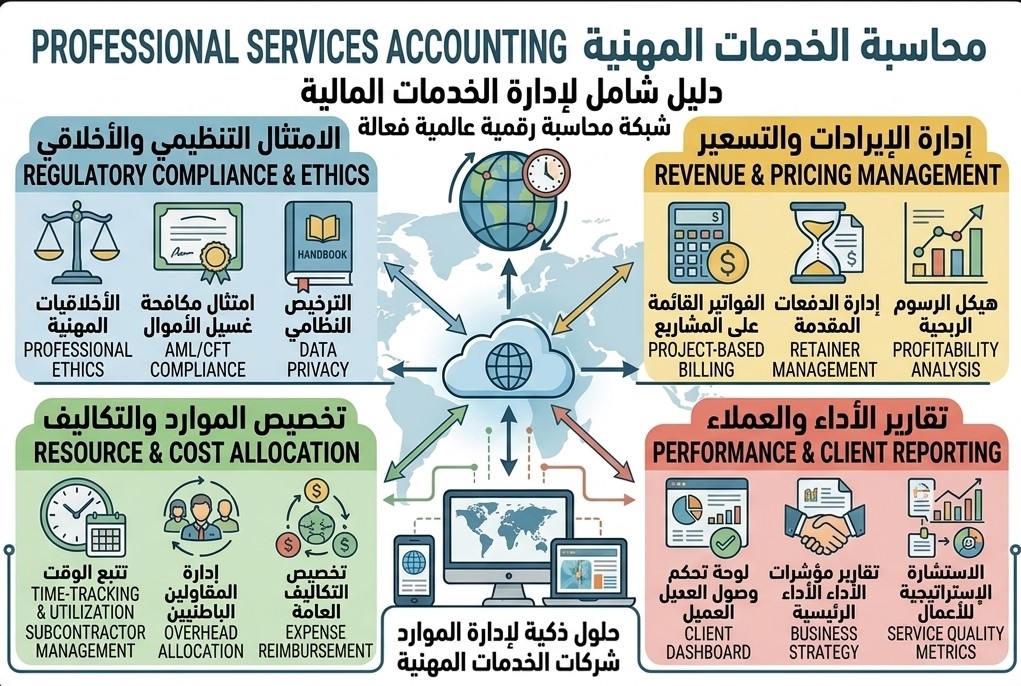
Accounting for professional services and consulting companies is different from trading and inventory accounting. The issue is not only buying and selling goods, but also contracts, fees, working hours, projects, advance payments, milestones, employees, subcontractors, and expenses connected with each client.
A company may generate good revenue, but real profit can be affected by staff time, consultant cost, direct expenses, overheads, discounts, delayed collections, and projects that take longer than expected.
Al Basma helps professional services and consulting companies organize accounts, follow up projects and contracts, reconcile collections, review VAT, prepare Corporate Tax files, and issue clear reports on client and service profitability.
Service companies depend on knowledge, time, and expertise more than inventory. Therefore, accounts should show not only revenue and expenses, but also the cost of delivering the service and the profitability of each contract, client, employee, or department.
A company may have monthly retainers, fixed-fee projects, hourly services, advance payments, project milestones, commissions, or success fees. Each revenue model needs clear accounting treatment.
If collections are recorded without linking them to contracts, projects, and expenses, management may not know whether the client is profitable, whether pricing is suitable, or whether the team’s time is being used effectively.
Organizing consulting contracts, monthly fees, projects, reports, clients, expenses, and VAT.
Tracking campaigns, clients, expenses paid on behalf of clients, subcontractors, platforms, and campaign profitability.
Organizing development contracts, subscriptions, support, hosting, digital services, and project milestones.
Tracking design projects, production, photography, content, subcontractors, usage rights, and profitability by client.
Organizing engineering service contracts, milestones, consultants, drawings, variations, and claims.
Organizing management services, HR services, training, outsourcing, and ongoing service contracts.
Revenue in service companies may come in different forms, and each form affects invoicing, collections, and financial reporting. Revenue should therefore be separated by contract type and service nature.
The contract is the foundation of professional services accounting. It should show the scope of work, fee value, payment method, milestones, reimbursable expenses, and obligations of each party.
Where projects are long-term or include several stages, the company should track what has been completed, what has been invoiced, and what has been collected, so actual revenue does not get mixed with advance payments or uncollected amounts.
The largest cost in professional services companies is often the time of employees and experts. The company should know the cost of the team working on each client or project, not only total monthly salaries.
When time and cost are tracked, management can identify whether the project is profitable, whether the price covers the cost of delivery, and whether a client consumes more time than the contract value supports.
Many service companies use subcontractors, freelancers, or external experts to perform part of the work. The cost of these parties should be linked to the project or client that benefited from the service.
If these costs are recorded as general expenses only, project profitability may not appear correctly.
VAT in service companies should be reviewed based on the service type, customer location, place of use or benefit, contract, and invoice. Not all services are treated the same way, especially when there are clients inside and outside the UAE, digital services, or services connected with foreign entities.
The company should review whether prices are VAT-inclusive or VAT-exclusive, whether invoices contain the required details, and whether expenses paid on behalf of a client are part of the consideration or only reimbursed amounts based on the documents and agreement.
VAT registration thresholds should also be monitored because service companies may exceed the threshold through monthly contracts or repeated projects, even if they do not have inventory or traditional trading activity.
We review invoices, service descriptions, fee value, VAT, and the link with the contract or work order.
We review client location, service nature, and supporting documents before deciding the appropriate tax treatment.
We review expenses paid on behalf of clients and whether they should be included in the invoice or treated separately based on documents.
Corporate Tax depends on correct profit, and correct profit in service companies can only be identified after organizing revenue, contracts, payroll, staff cost, subcontractors, direct expenses, overheads, and advance payments.
Mixed or personal expenses, related party transactions, shareholder loans, expenses paid from personal accounts, and services between related companies should also be reviewed.
Where the company is located in a Free Zone, has foreign clients, or deals with related companies, accounts should be reviewed more carefully before Corporate Tax filing.
Service companies may issue many invoices, but collection can be delayed because of approvals, reports, milestones, or disputes over the scope of work. Customer ageing and collections should therefore be followed up periodically.
Weak collection follow-up may create cash pressure even if the company is profitable on paper.
Service companies often depend heavily on marketing, relationships, and sales. Expenses may include advertising, sales commissions, meetings, travel, digital platforms, software subscriptions, technical tools, and business development costs.
These expenses should be classified clearly, separating company expenses from personal expenses and from expenses paid on behalf of a specific client.
Professional services companies may deal with clients outside the UAE or issue invoices in foreign currencies. Invoices, transfers, exchange rates, and exchange differences should therefore be recorded clearly.
The company should also follow the contract terms, client location, service nature, and supporting documents because these may affect VAT and tax reporting.
Al Basma organizes service company accounts by linking contracts, invoices, collections, projects, employees, subcontractors, expenses, and tax files in one clear accounting process.
We help follow up advance payments, unbilled work, project profitability, client balances, VAT, and Corporate Tax.
We also prepare periodic reports that help management identify the most profitable clients, loss-making projects, high expenses, delayed collections, and tax position.
Related Updates and Articles
Call +971506861518
Whatsapp: 00971525886295
EMAIL : info@albasmaa.com


To Know our Services, Don't wait call us or leave your Number in online Chat with time you can received our call and we will call you back or send Email to info@albasmaa.com now.

For join for our team please to send C.V. for Waleed@albasmaa.com