

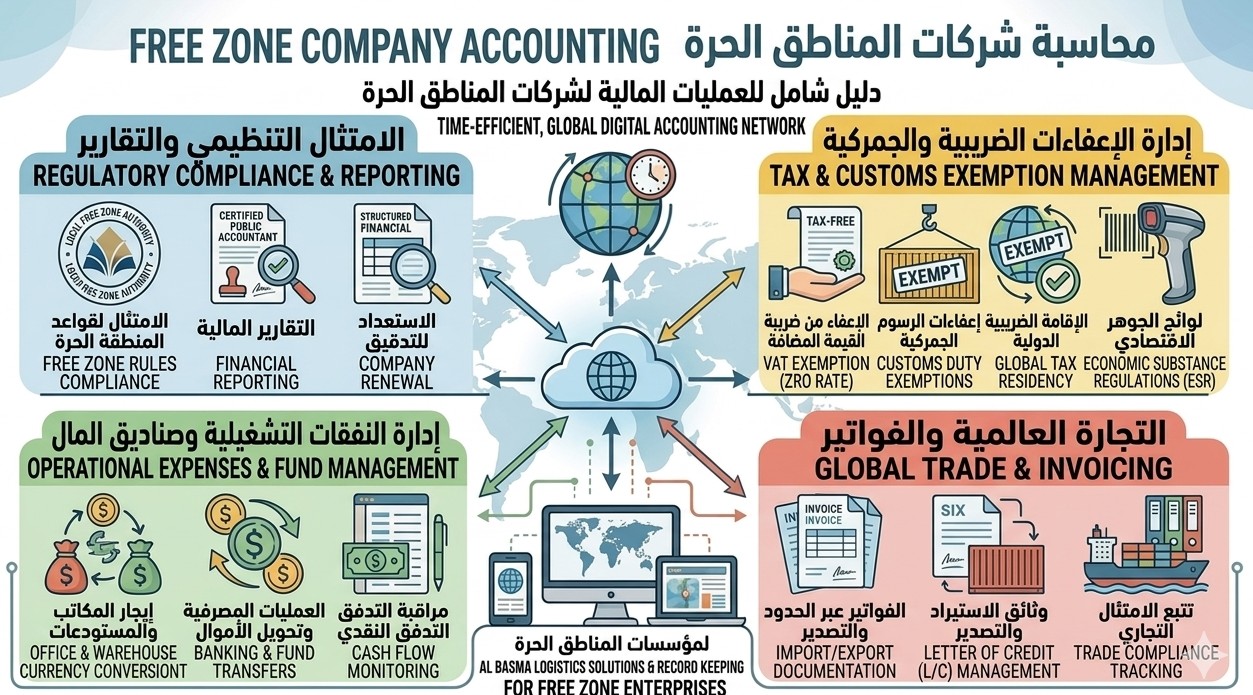
Free Zone companies in the UAE need organized accounting records, even where the company is small or has limited staff. The company may need financial statements, audit support, Corporate Tax registration, VAT review, licence renewal support, and reconciliation of transactions with customers and suppliers inside and outside the UAE.
Being incorporated in a Free Zone does not mean that accounting and tax obligations are automatically removed. The company should understand its activity, type of income, customer location, relationship with mainland businesses, and whether it aims to maintain the status of a Qualifying Free Zone Person.
Al Basma helps Free Zone companies organize accounts, prepare financial statements, prepare audit files, review VAT, review Corporate Tax, and analyse qualifying and non-qualifying transactions.
Free Zone companies may carry out trading, services, import and export, business within the Free Zone, transactions with mainland companies, related party transactions, or international activities. Each type of activity requires clear accounting and tax classification.
General bookkeeping alone is not enough if it does not show the source of income, customer type, place of supply, nature of expense, relation of the transaction to the Free Zone, and whether the income may qualify for the Free Zone Corporate Tax regime.
Accounts should therefore be prepared in a way that supports financial statements, audit, Corporate Tax, VAT, and management reporting, not only bank and expense recording.
Organizing service income, contracts, customers inside and outside the UAE, expenses, VAT, and Corporate Tax.
Tracking imports, exports, inventory, customs documents, cost of goods, customers, suppliers, and VAT.
Organizing international invoices, foreign currencies, overseas customers, transfers, and UAE tax obligations.
Tracking inventory, distribution, designated zones, transport, delivery, cost of goods, and profitability reports.
Reviewing intercompany transactions, mutual balances, shared expenses, and transfer pricing documentation.
Preparing accounts, financial statements, and audit files for the Free Zone, banks, partners, or Corporate Tax purposes.
The first step for Free Zone companies is to maintain clear and complete accounts. Revenue, expenses, assets, liabilities, customers, suppliers, inventory, banks, loans, and shareholder balances should be recorded in a way that supports proper financial statements.
Financial statements are not needed only for audit purposes. A company may need them for opening a bank account, licence renewal, admitting a partner, obtaining finance, filing Corporate Tax returns, or proving its financial position.
Free Zone companies are within the scope of UAE Corporate Tax, but the treatment differs depending on whether the company is a Qualifying Free Zone Person, whether the income is Qualifying Income, and whether the company satisfies the required conditions.
The accounts should therefore clearly show the type of revenue, customers, and transactions, because the company may need to separate qualifying income from income subject to the standard Corporate Tax rate and review substance, activity, documentation, and audit requirements.
Transactions with mainland companies, related parties, permanent establishments, real estate, intellectual property, passive income, and distribution from or within designated zones may also require review when relevant.
We review whether the company meets the conditions of a Qualifying Free Zone Person and whether the income can be classified as Qualifying Income.
We help separate revenue based on activity, customer type, location, and supporting documentation.
We prepare accounts, financial statements, and supporting files required for audit or Corporate Tax.
VAT for Free Zone companies should be reviewed separately from Corporate Tax. Being located in a Free Zone does not automatically remove the VAT registration obligation, because VAT registration depends on taxable supplies, imports, and the registration thresholds.
The company should also distinguish between ordinary Free Zones and Designated Zones for VAT purposes, and between the sale of goods, services, imports, exports, supplies inside the UAE, and out-of-scope supplies.
Sales invoices, customer contracts, customs documents, shipping documents, place of supply, and the nature of the goods or services should be reviewed before deciding the VAT treatment.
Many Free Zone companies deal with customers or suppliers in the UAE mainland. These transactions need clear classification for accounting, VAT, and Corporate Tax purposes.
The company should identify whether the transaction is a sale of goods, provision of services, distribution, supply inside the UAE, related party transaction, or a transaction that may affect the company’s status as a Qualifying Free Zone Person.
Free Zone companies engaged in trading or distribution need an accounting system that connects imports, exports, inventory, customs documents, freight, and cost of goods.
Where a Designated Zone is relevant for VAT purposes, or goods enter and leave the UAE or the Free Zone, clear documents should be retained to prove the movement of goods and the nature of the supply.
If the Free Zone company is engaged in trading, inventory movement should be clear. Inventory may be held in a Free Zone warehouse, a Designated Zone, with a third party, or in transit to the customer.
Cost of goods should be calculated correctly, including purchase price, freight, customs, insurance, and direct costs, then linked with sales so that the real gross margin appears.
Many Free Zone companies deal with customers and suppliers outside the UAE in foreign currencies. Invoices, transfers, exchange rates, and exchange differences should therefore be recorded properly.
Foreign customer and supplier balances, transfers between accounts, and amounts paid on behalf of the company or by related parties should also be monitored.
Free Zone companies may deal with subsidiaries, sister companies, owners, directors, or related parties inside or outside the UAE. These transactions should be clear and supported by contracts, invoices, and documents.
Related party transactions may include management services, rent, loans, transfers, sales and purchases, shared expenses, or the use of common staff and offices.
Some Free Zones require audited financial statements, and some companies need audit for Corporate Tax, banking, partners, licence renewal, or internal compliance purposes.
Even where audit is not required in every case by the Free Zone, organized accounts and ready financial statements help the company deal with banks, tax authorities, partners, and official entities.
Free Zone companies often need a bank account, bank file update, or documents proving business activity. Organized accounts help prove the nature of revenue, expenses, transfers, and source of funds.
Clear contracts, invoices, shipment records, and bank transfers reduce problems when banks request additional documents or review the company account.
Al Basma organizes Free Zone company accounts by connecting invoices, contracts, banks, customers, suppliers, inventory, shipments, related parties, and tax files in one clear accounting process.
We help prepare financial statements, audit files, VAT review, Corporate Tax review, income classification, and QFZP support where needed.
We also prepare periodic reports that help management understand profitability, obligations, collections, expenses, tax position, and bank or Free Zone requirements.
Related Updates and Articles
Call +971506861518
Whatsapp: 00971525886295
EMAIL : info@albasmaa.com


To Know our Services, Don't wait call us or leave your Number in online Chat with time you can received our call and we will call you back or send Email to info@albasmaa.com now.

For join for our team please to send C.V. for Waleed@albasmaa.com