




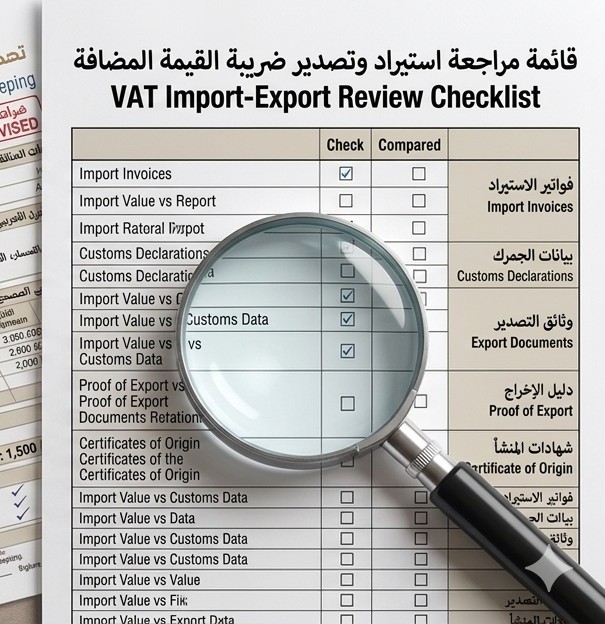
Companies involved in trading, imports, or exports usually face more VAT challenges than simple local businesses. Their VAT file does not depend only on sales and purchase invoices, but also on customs records, shipping documents, proof of export, zero-rated supplies, and import VAT.
A company may have overseas sales or goods imported from foreign suppliers, but errors in linking documents to the VAT return may create differences between accounting records, customs records, and the submitted VAT return.
Al Basma helps companies review the VAT impact of imports and exports and match customs documents, shipping documents, invoices, VAT returns, and accounting records.
In local transactions, the link between the invoice, VAT amount, and VAT return is often clearer. In import and export transactions, there may be several parties involved, such as the foreign supplier, shipping company, customs broker, customs authority, payment platform, and overseas customer.
As a result, the error may appear in different places: the commercial invoice value, import declaration, freight and insurance value, import VAT, export evidence, or the way the transaction is reported in the VAT return.
A proper review helps the company understand whether imports were recorded correctly, whether exports are supported by sufficient documents, and whether overseas transactions were properly classified in the VAT return.
Importing goods into the UAE requires careful review because customs records may not appear in the same way as invoices recorded in the accounting software. The value of goods in the import declaration may also differ from the supplier invoice because of freight, insurance, customs fees, or currency differences.
A VAT-registered company should confirm that import VAT was linked to the correct TRN, that import records were reflected properly in the VAT return, and that input tax related to imports was treated correctly.
Where the importer is not registered for VAT, the payment and treatment of import VAT may differ depending on the case and the applicable customs and tax procedures.
We review the supplier invoice, currency, shipping terms, value of goods, and the link with the import declaration and accounting records.
We review customs records, declaration number, import value, import VAT, and the link with the TRN and VAT return.
We review how import VAT appears in accounting records and VAT returns, and whether it was treated as output tax and input tax depending on the case.
Exports of goods and some services supplied outside the UAE may be subject to VAT at the zero rate. However, this does not mean that every invoice to an overseas customer is automatically zero-rated without sufficient supporting documents.
For export of goods, the company usually needs documents proving that the goods left the UAE, such as shipping documents, customs export declarations, bills of lading, or other documents showing the movement of goods.
For export of services, the nature of the service, the customer’s location, the place of use and enjoyment, and any special conditions should be reviewed before deciding the VAT treatment.
We review the invoice, shipping documents, proof of goods leaving the UAE, and the link between the sale, export, and VAT return.
We review the nature of the service, overseas customer, place of use and enjoyment, and correct classification in the VAT return.
We review whether the documents are sufficient to support zero-rating and whether they can be linked to the invoice, payment, and movement of goods or services.
The practical review starts by comparing import and customs records with purchase records and VAT ledgers. Then, differences are identified between the goods value, VAT amount, currency, related expenses, and the tax period in which the transaction was recorded.
For exports, the sales invoice is linked to shipping documents, export evidence, or proof of service supplied outside the UAE. Then we confirm that the transaction appears in the correct box of the VAT return.
This link is very important because the FTA may not only ask about the VAT return figure. It may request the document that supports why the transaction was treated as an import, export, zero-rated supply, or outside-scope transaction.
Al Basma reviews import and export transactions and matches supplier and customer invoices with customs documents, shipping records, accounting records, and VAT returns.
We also help companies prepare a clear supporting document file linking the import or export transaction to the original invoice, accounting entry, payment, customs documents, shipping documents, or service evidence.
We provide practical recommendations to deal with differences, improve accounting software recording, and organize VAT documents related to international trade.
Related Updates and Articles
Call +971506861518
Whatsapp: 00971525886295
EMAIL : info@albasmaa.com


To Know our Services, Don't wait call us or leave your Number in online Chat with time you can received our call and we will call you back or send Email to info@albasmaa.com now.

For join for our team please to send C.V. for Waleed@albasmaa.com