What Is Monthly Accounting Review?
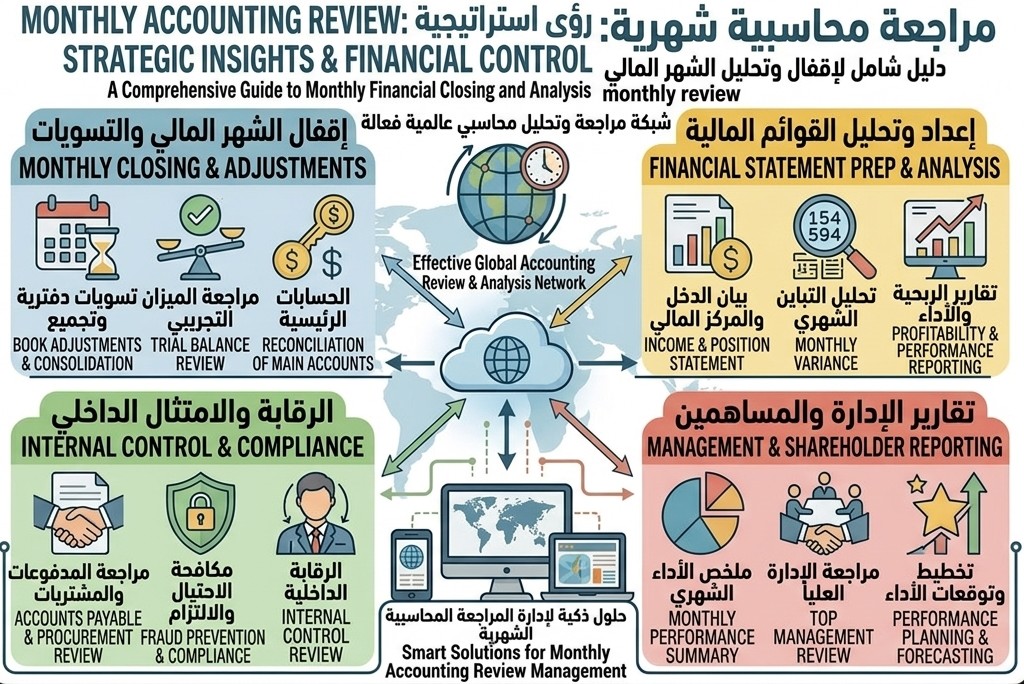
Monthly accounting review is an organized check of the company’s accounts at the end of each month or periodic accounting cycle. It confirms that entries, invoices, banks, customers, suppliers, expenses, and tax records are recorded correctly.
The purpose is to identify errors early instead of waiting until year-end. When each month is closed properly, financial reports, VAT, Corporate Tax, and audit become easier and more accurate.
Monthly review also helps management understand sales, expenses, profit, cash position, delayed customers, due suppliers, and risks that need early action.
The common mistake is that a company records data, but does not review whether the data is correct and matched with banks, invoices, and tax files.
When Does a Company Need Monthly Accounting Review?
Bank Differences
When the company has several bank accounts, POS machines, payment gateways, or cheques that need periodic reconciliation.
Many Customers and Suppliers
When there are many invoices, receipts, payments, advance payments, or old balances that need follow-up.
VAT and Corporate Tax
When the company needs an organized tax file instead of collecting documents only when the filing deadline approaches.
Recurring Sales and Purchases
When the company has daily sales, many purchases, inventory, returns, discounts, or frequent transactions.
Management Reports
When management needs monthly figures for profit, expenses, cash flow, customers, and operating performance.
Audit or Financial Statements
When the company wants to prepare accounts early instead of discovering errors at year-end.
Bank and Collection Review
The first item in monthly review is the bank. The bank statement should be matched with the accounting records, and every receipt, payment, charge, transfer, cheque, and payment gateway movement should be reviewed.
If the bank is not reconciled, all reports may be inaccurate because receipts and payments are the basis for customer, supplier, and expense tracking.
- Matching bank statements with bank accounts in the books.
- Reviewing receipts and linking them with customers and invoices.
- Reviewing payments and linking them with suppliers and expenses.
- Recording bank charges, card charges, and transfer fees.
- Following up issued and received cheques.
- Matching POS and payment gateways with the bank.
- Reviewing transfers between company bank accounts.
- Identifying unknown or unrecorded bank movements.
Customer and Supplier Review
After bank reconciliation, customer and supplier balances should be reviewed. The bank account may be reconciled, while a customer or supplier balance remains incorrect because an entry was recorded in the wrong account or a payment was not linked with the invoice.
Monthly review reduces the accumulation of old balances, improves collection, and helps the company identify overdue customers and due suppliers.
- Matching customer invoices with receipts.
- Reviewing uncollected invoices.
- Analysing customer ageing reports.
- Matching supplier invoices with payments.
- Reviewing unpaid supplier invoices.
- Settling advance payments from customers and to suppliers.
- Reviewing credit notes, discounts, and returns.
- Identifying old or unexplained balances.
Old balances do not appear suddenly at year-end. They usually start as small monthly differences and accumulate over months or years.
Sales and Invoice Review
Every month, the company should confirm that all sales are recorded, invoices are complete, and returns, discounts, and credit notes have been recorded properly.
In some activities, sales may come from POS, e-commerce platforms, bank cards, contracts, or projects. The source of sales should therefore be matched with invoices and accounting records.
- Reviewing sales invoice sequence.
- Matching sales with POS or sales system reports.
- Matching sales with receipts and bank movements.
- Reviewing discounts, offers, and settlements.
- Recording returns and credit notes.
- Checking tax invoice details.
- Reviewing cash and credit sales.
- Identifying unrecorded sales or duplicated invoices.
Purchase and Expense Review
Monthly expenses need document review because some expenses may be unsupported, duplicated, personal to the owner, or related to another period.
Supplier invoices should also be checked to confirm they include the required details, and input VAT should only be recorded on valid documents where applicable.
- Reviewing purchase and expense invoices.
- Confirming that every expense has a supporting document.
- Separating company expenses from owner personal expenses.
- Identifying duplicated or unapproved invoices.
- Reviewing expenses paid in cash or from personal accounts.
- Recording accrued expenses where needed.
- Recording prepaid expenses where needed.
- Reviewing supplier invoices and input VAT.
Monthly VAT Review
Even where VAT returns are filed quarterly or under another tax period, monthly VAT review helps reduce errors before the filing deadline.
Monthly review helps confirm that sales invoices, purchase invoices, credit notes, returns, and supplies inside and outside the UAE have been classified correctly.
Monthly review also helps monitor the VAT registration threshold for unregistered companies, especially where sales or contracts are increasing continuously.
- Reviewing output VAT on sales.
- Reviewing input VAT on purchases.
- Reviewing tax invoices and credit notes.
- Reviewing taxable, exempt, and out-of-scope supplies where needed.
- Matching VAT with invoices, banks, and reports.
- Preparing a supporting document file before filing.
- Identifying errors before they accumulate in the tax period.
- Monitoring VAT registration or deregistration where needed.
Monthly Corporate Tax Review
Corporate Tax is filed annually, but its basis is created every month through revenue, expenses, balances, and accounting entries.
If personal expenses are mixed with company expenses, advance payments are not classified, or customer and supplier balances are not reconciled, accounting profit may appear incorrectly.
- Reviewing monthly revenue and expenses.
- Separating expenses not related to business activity.
- Reviewing personal or mixed expenses.
- Tracking fixed assets and depreciation.
- Reviewing loans, advances, and shareholder accounts.
- Reviewing related party transactions where needed.
- Reviewing accrued and prepaid expenses.
- Preparing accurate figures for annual reports and Corporate Tax.
Corporate Tax does not start only at the filing deadline. It starts from how revenue, expenses, and accounting entries are recorded every month.
Inventory and Fixed Asset Review
If the company has inventory or fixed assets, they should be reviewed monthly or periodically depending on the nature of the activity. Inventory affects cost of sales and profit, while fixed assets affect depreciation and financial statements.
A company may appear profitable or loss-making because cost of goods, damaged inventory, or asset purchases were not recorded correctly.
- Reviewing inventory movement, purchases, and sales.
- Matching physical stock with the system where needed.
- Recording cost of goods sold.
- Reviewing damaged, obsolete, or returned stock.
- Recording new fixed assets.
- Calculating periodic depreciation.
- Separating fixed assets from operating expenses.
- Following up asset sale or disposal.
Payroll, Loans, and Shareholder Accounts Review
Payroll, loans, and shareholder accounts may cause differences if they are not reviewed monthly. There may be accrued salaries, employee advances, loans, transfers to shareholders, or expenses paid from personal accounts.
- Matching payroll with salary transfers.
- Reviewing advances, deductions, and allowances.
- Recording accrued salaries where needed.
- Reviewing loans and finance instalments.
- Reconciling shareholder and owner accounts.
- Separating personal withdrawals from company expenses.
- Recording expenses paid from personal accounts.
- Reviewing transfers between related companies.
Monthly Accounting Closing
Monthly closing means that the month has been reviewed, key balances are clear, and reports can be relied upon. It does not prevent later adjustment if a new document appears, but it reduces random changes and accumulated errors.
- Recording all sales and purchase invoices.
- Recording all receipts and payments.
- Reconciling banks and cash accounts.
- Reviewing customers and suppliers.
- Reviewing VAT and tax documents.
- Reviewing expenses, assets, and inventory.
- Preparing monthly adjustment entries.
- Issuing the monthly review report to management.
Documents Required for Monthly Review
- Monthly bank statements.
- Sales invoices and POS or system reports.
- Purchase and expense invoices.
- Receipt, payment, and transfer documents.
- Customer and supplier reports.
- Inventory reports where applicable.
- Payroll and salary transfer schedules.
- Rent, utility, and recurring expense invoices.
- Credit notes, returns, and discounts.
- Loan or finance reports where applicable.
- Contracts, advance payments, or work-in-progress documents.
- Previous VAT and Corporate Tax files where needed.
Steps to Perform Monthly Accounting Review
- Identify the month or period to be reviewed.
- Receive documents, bank statements, and reports.
- Review completeness of sales and purchase invoices.
- Reconcile banks and payment channels.
- Match customers, suppliers, receipts, and payments.
- Review expenses, assets, and inventory.
- Review VAT and invoice classification.
- Review accounting entries and monthly adjustments.
- Prepare a list of notes and errors.
- Prepare correction entries where needed.
- Issue monthly reports to management.
- Provide recommendations to improve the system and documents.
Common Errors Found During Monthly Review
- Not reconciling bank accounts monthly.
- Recording receipts as revenue without linking them to customers.
- Recording payments as expenses without linking them to suppliers.
- Missing expense or purchase invoices.
- Duplicated invoices or entries.
- Missing bank and card charges.
- Mixing company expenses with owner personal expenses.
- Not recording credit notes or returns.
- Reviewing VAT only shortly before the filing deadline.
- Leaving old balances without explanation.
- Not tracking inventory or cost of sales.
- Postponing corrections until year-end.
The biggest risk of not performing monthly review is that small errors accumulate until they become a major problem during VAT filing, Corporate Tax filing, or audit.
Reports You Receive Monthly
- Monthly sales report.
- Monthly expense report.
- Monthly profit or loss report.
- Bank reconciliation report.
- Customer, collection, and ageing report.
- Supplier and payment report.
- VAT report and tax notes.
- Unsupported or missing expense report.
- Balances requiring correction.
- Management recommendations to improve accounts and control.
Who Needs This Service?
- Companies that need regular monthly reports.
- VAT-registered companies.
- Companies preparing for Corporate Tax.
- Companies with many bank accounts, POS machines, or payment gateways.
- Companies with many customers and suppliers.
- Companies with inventory or daily sales.
- Companies with repeated accounting differences.
- Companies that do not want to wait until year-end to discover errors.
- Companies preparing for audit or financial statements.
- Companies that want to improve control, cash flow, and profitability.
How Can Al Basma Help with Monthly Accounting Review?
Al Basma reviews accounts monthly by checking banks, customers, suppliers, sales, purchases, expenses, VAT, and key balances.
We identify errors and differences, prepare correction entries, and issue a monthly report showing the status of the accounts and the items that need attention.
We also help management read the figures in a practical way: where profit is generated, where expenses are high, which customers are delayed, which invoices are missing, and which risks should be addressed before year-end.
Services Related to Monthly Accounting Review
Why Choose Al Basma for Monthly Review?
- Organized monthly review instead of waiting until year-end.
- Reconciliation of banks, customers, suppliers, and invoices.
- Early identification of errors and differences.
- Continuous preparation of VAT and Corporate Tax files.
- Clear monthly reports for management.
- Practical recommendations to improve controls, documents, and profitability.
Important Notice:
The information provided on this page is intended for general informational purposes only and does not constitute legal, tax, accounting, or professional advice. It should not be relied upon as a substitute for reviewing the applicable laws, regulations, decisions, and official guidance issued by the competent authorities in the United Arab Emirates.
The appropriate legal, tax, or accounting treatment may vary depending on the specific facts and circumstances of each case.
If you require professional advice or assistance relating to your particular situation, please contact us and our team will be pleased to review your case and provide appropriate support.
Related Updates and Articles