

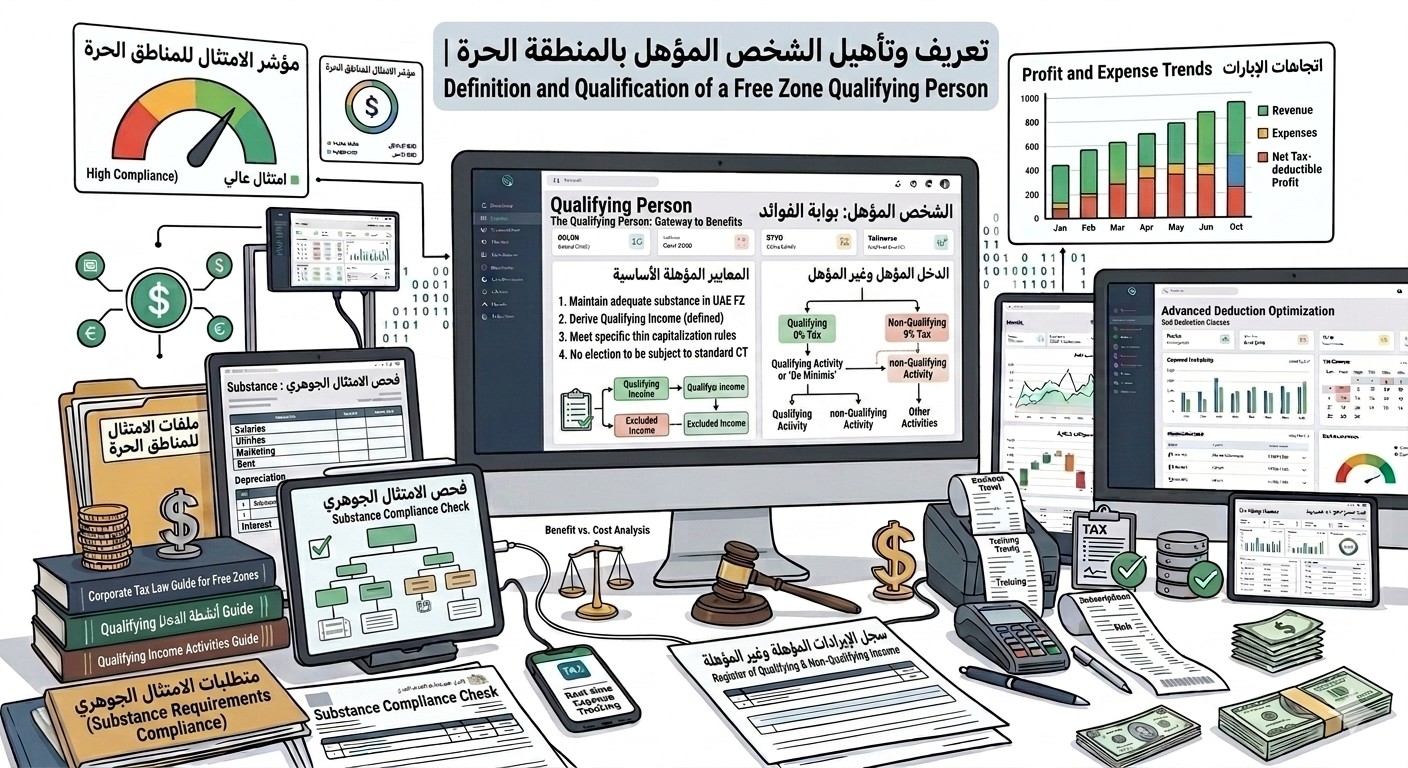
Being established in a Free Zone does not automatically mean that all company income is subject to 0% Corporate Tax. A Free Zone company may fall within the UAE Corporate Tax regime, but it may benefit from the Qualifying Free Zone Person regime only if the required conditions are met.
The 0% rate is linked to Qualifying Income, not necessarily to every source of income of the company. Therefore, the activity, place of activity, customers, contracts, invoices, related parties, and non-qualifying income should be reviewed before filing the Corporate Tax return.
Al Basma helps Free Zone companies review their QFZP status, determine whether the conditions are met, identify qualifying income, and highlight risks or missing documents before filing.
QFZP stands for Qualifying Free Zone Person. It refers to a juridical person established in a Free Zone that meets specific conditions to benefit from the 0% Corporate Tax rate on Qualifying Income.
This regime does not mean that the company is free from compliance obligations. A Free Zone company may still need to register for Corporate Tax, maintain records, prepare financial statements, file the Corporate Tax return, and comply with the Qualifying Income conditions.
For this reason, QFZP should be treated as a complete tax compliance file, not as an automatic benefit because the trade licence was issued by a Free Zone authority.
When reviewing the position of a Qualifying Free Zone Person, it is not enough to look at the trade licence only. Several conditions, documents, activities, and income streams should be reviewed.
The company should be established in a Free Zone, with review of the licence, place of business, and how the activity is carried on in or from the Free Zone.
We review whether the company has appropriate substance, such as office space, employees, assets, management, and operating expenses related to its activity.
We review income sources, customers, activity, contracts, and invoices to identify qualifying income and non-qualifying income.
We review whether the company has elected to be subject to the ordinary Corporate Tax regime instead of the Free Zone regime, as this affects the tax treatment.
We review related party and connected person transactions and whether documentation or analysis is needed to support prices and arrangements.
We review audited financial statement requirements and accounting records, because financial statements may be an important part of the compliance file.
Qualifying Income is income that may benefit from the 0% Corporate Tax rate if the company is a Qualifying Free Zone Person and the conditions of the regime are met. Identifying this income requires a practical review of the activity, customer type, place of supply, and transaction nature.
Some income may arise from transactions with other Free Zone Persons, qualifying activities, or specific permitted transactions. On the other hand, certain activities or transactions may be excluded, or may create non-qualifying income subject to ordinary treatment.
Therefore, the activity title in the licence is not enough. Actual operations, invoices, contracts, and transaction flows should be reviewed to determine whether income is qualifying or not.
A Free Zone company may have both qualifying and non-qualifying income in the same tax period. Having some non-qualifying income does not always mean that the whole company loses the benefit, but the thresholds, conditions, and impact on QFZP status should be carefully reviewed.
Certain activities or transactions may be excluded from the 0% regime or may create non-qualifying income, especially where there are mainland transactions, related party arrangements, activities that are not qualifying, or income from a permanent establishment outside the Free Zone.
For this reason, a separate analysis should be prepared for income by customer type, activity, location, and supporting documents so that the 0% rate is not applied to income that does not qualify.
In some cases, the rules may allow a limited amount of non-qualifying revenue without losing the regime, provided the permitted limits are not exceeded. Calculating these limits requires accurate classification of qualifying income, non-qualifying income, and total revenue.
The practical issue is that many companies do not separate revenue by customer type, activity, or income source, which makes the De Minimis test difficult when preparing the return or responding to a document request.
Al Basma helps prepare a clear schedule showing qualifying income, non-qualifying income, excluded income, and the impact on the QFZP position.
Some Free Zone companies involved in the distribution of goods or materials in or from a Designated Zone may need to review additional compliance procedures under recent official updates. These procedures should not be generalized to every Free Zone company or every activity.
If the company is involved in trading or distributing goods from a Designated Zone, the activity, movement of goods, purchase and sales documents, warehouses, shipping, customers, and possible additional QFZP compliance requirements should be reviewed.
If the company is operating in a service, consulting, or logistics activity that is not within the specific distribution scope, the same additional distribution procedures may not apply. However, the general QFZP conditions and compliance requirements should still be reviewed according to the facts.
When preparing the Corporate Tax return for a Free Zone company, it should first be determined whether the company qualifies for the Free Zone regime. Then, qualifying income should be separated from any other income that may be subject to ordinary Corporate Tax treatment.
If the company has qualifying income, that income may benefit from the 0% rate. If there are transactions or income that do not qualify, their effect on the return and on the company’s continued QFZP status should be analyzed.
The return should therefore be based on a clear schedule linking each income type to documents, contracts, and invoices, not on a general assumption that the company is established in a Free Zone.
Al Basma reviews the Free Zone company file, including licence, activity, customers, contracts, invoices, financial statements, related party transactions, and qualifying or non-qualifying income.
We help prepare a clear analysis showing whether the company meets the Qualifying Free Zone Person conditions, which income may benefit from the 0% rate, and which items require adjustment or additional documents.
We also help prepare a supporting file before Corporate Tax filing, connect financial statements with revenue, activities, and documents, and review any additional procedures that may apply based on the nature of the company’s activity.
Related Updates and Articles
Carefully selected accredited providers, with pricing and service suited to your business.
Explore the ServiceCall +971506861518
Whatsapp: 00971525886295
EMAIL : info@albasmaa.com


To Know our Services, Don't wait call us or leave your Number in online Chat with time you can received our call and we will call you back or send Email to info@albasmaa.com now.

For join for our team please to send C.V. for Waleed@albasmaa.com