عربي
Home Accounting Accounting & BookKeeping Auditing UAE TAX Consultant Report Business Support Governance & Compliance Updated & News About Us


Gold and Jewellery Accounting in UAE

Gold and Jewellery Accounting in UAE

Do You Know the Profit of Gold or Only the Selling Price?

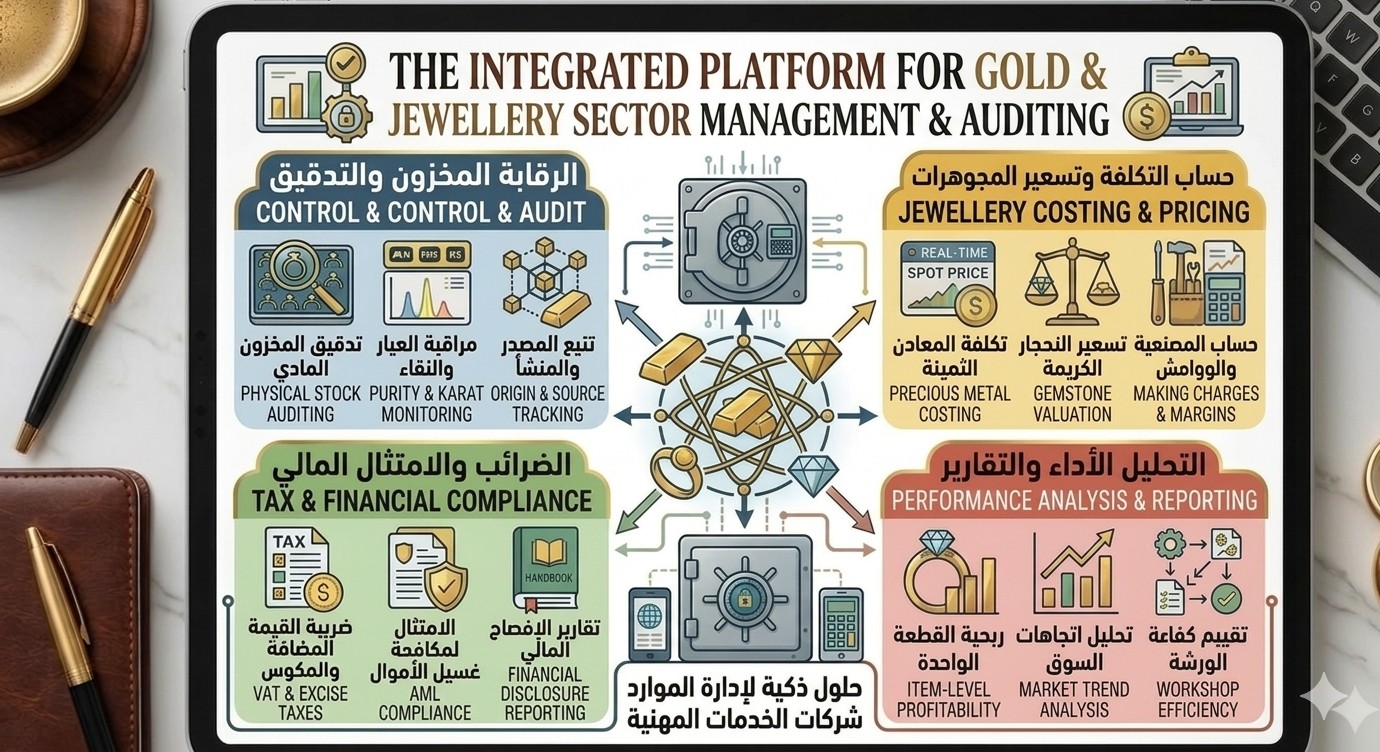
Accounting for gold and jewellery businesses is different from ordinary trading accounting because inventory is not measured only by item count. It should also be tracked by gram, karat, weight, making charge, stones, cost, market price, and real profit for each item or invoice.

A gold shop may sell new jewellery, buy old gold, exchange jewellery, sell diamonds or precious stones, add making charges, prepare custom orders, deal with VAT-registered suppliers, or sell to individuals and traders.

Al Basma helps gold and jewellery businesses organize accounts, track inventory by gram and karat, reconcile sales and purchases, review VAT, apply reverse charge where relevant, and prepare Corporate Tax and financial reports.

In gold businesses, profit does not appear from total sales only. Weight, karat, making charges, stones, purchase cost, old gold, and the difference between book cost and market price should all be clear.

Why Do Gold Shops Need Specialized Accounting?

Gold and jewellery trading depends on very detailed records. One invoice may include gold weight, karat, gram price, making charge, stones, discount, VAT, old gold exchange, and payment by cash and card in the same transaction.

If sales and purchases are recorded as amounts only, without tracking grams, karats, items, and inventory movement, the bank may look correct while inventory, profit, and tax records are inaccurate.

Gold shops therefore need an accounting process that links each item or group with inventory, cost, invoice, customer, and supplier, with reports that help management understand real profit and reconcile physical stock with accounting records.

The common mistake is recording the invoice value only, without recording weight, karat, making charges, stones, old gold, and inventory movement.

Types of Gold and Jewellery Businesses We Serve

Gold and Jewellery Shops

Organizing daily sales, inventory, grams, karats, making charges, purchases, VAT, and financial reports.

Wholesale Gold Traders

Tracking trader-to-trader sales, suppliers, reverse charge, balances, shipments, and supporting documents.

Jewellery Workshops

Tracking gold sent for manufacturing, loss, making charges, labour, materials, finished items, and final cost.

Diamonds and Stones

Organizing stones, certificates, weight, cost, sales, inventory, invoices, and the appropriate VAT treatment.

Old Gold and Exchange

Recording old gold purchases, exchange transactions, cash differences, remanufacturing, variances, and settlements.

Showrooms and Branches

Preparing sales, inventory, and profitability reports for each branch, showroom, salesperson, or product line.

Gold Inventory by Gram and Karat

Gold inventory should not be recorded as value only. The company should know how many grams it holds in each karat, which items are available, and what the cost of each group, item, or shipment is.

Inventory may include new jewellery for sale, old gold purchased from customers, gold under manufacturing, items held by a workshop, separate stones, or stone-set jewellery. Each category needs separate tracking.

  • Weight in grams for each item or group.
  • Karat: 24, 22, 21, 18, or other karats depending on the activity.
  • Gross weight and net weight where stones are included.
  • Purchase cost or manufacturing cost.
  • Making charges added or paid.
  • Stones, pearls, diamonds, and certificates.
  • Old gold and exchanged jewellery.
  • Items under manufacturing or held by workshops.
  • Differences between physical stock and books.
  • Inventory report by branch, karat, or item type.

In gold businesses, stock count by value is not enough. Weight, karat, item count, and cost should match between the system and physical inventory.

Sales, Making Charges, and Real Profit

A gold sales invoice may include metal value, making charge, stone value, discount, VAT, and old gold exchanged by the customer. The invoice should therefore be detailed enough to show real profit.

A shop may sell at a high price while profit is low because of high purchase cost, discounts, unseparated making charges, or incorrect recording of old gold.

  • Gram price at the time of sale.
  • Weight and karat of each item.
  • Making charge or design fee.
  • Value of stones or diamonds, where applicable.
  • Discounts and offers.
  • VAT based on the correct treatment.
  • Amount paid by cash or card.
  • Value of old gold exchanged, where applicable.
  • Cost of the item sold.
  • Profit margin by invoice or item.

Purchases and Suppliers

Gold purchases may be made from local suppliers, wholesalers, Free Zones, foreign suppliers, or customers selling old gold. Each source needs clear documents, invoices, and classification.

Supplier invoices should be matched with weight, karat, and stock received. Supplier payments, balances, price differences, and settlements should also be followed up.

  • Gold and jewellery purchase invoices.
  • Gold weight, karat, and cost.
  • Making charges or manufacturing charges.
  • Stone or diamond invoices.
  • Shipping or import documents where there is a foreign supplier.
  • Supplier settlements and discounts.
  • Supplier balances and payments.
  • Classification of normal purchases and reverse charge purchases where relevant.
  • Matching purchases with inventory receipt.

Old Gold, Exchange, and Remanufacturing

Buying or exchanging old gold from customers is one of the most sensitive transactions. A customer may sell old gold, exchange it for a new item, pay a cash difference, or receive a refund.

The shop should identify the weight, karat, price, and value of the old gold, and whether it will enter inventory as scrap gold, be remanufactured, be sold, or be settled against a new sales invoice.

  • Customer details and purchase receipt or invoice.
  • Weight and karat of old gold.
  • Valuation price at the time of purchase or exchange.
  • Discount or settlement value in the sales invoice.
  • Cash difference paid or refunded.
  • Old gold movement into inventory.
  • Sending old gold for manufacturing, melting, or resale.
  • Loss or weight difference during manufacturing.
  • Accounting and tax effect based on documents.

Old gold is not only a normal discount. It is an asset entering or leaving inventory, and its weight, karat, value, and later movement should be recorded.

VAT in Gold and Jewellery Trading

VAT in gold and jewellery requires careful review because a transaction may be a retail sale, a trader-to-trader sale, a supply of precious metals or stones, making service, export, import, or supply inside a Designated Zone.

Gold invoices should not all be treated in the same way. The business should review the nature of the goods, whether the recipient is VAT registered, whether required declarations exist, whether the transaction is retail or wholesale, and whether making charges are part of a composite supply or a separate service.

The business should also retain clear tax invoices, export or import documents, recipient declarations for reverse charge where applicable, and evidence of TRN verification where needed.

Reverse Charge

We review the conditions for applying the reverse charge mechanism between registrants, required declarations, and TRN verification.

Making Charges

We review whether making charge is part of a composite supply of jewellery or a separate service requiring different treatment.

Import and Export

We review customs, shipping, import, and export documents and link them with invoices and VAT returns.

Reverse Charge for Precious Metals and Stones

The local reverse charge mechanism may apply to certain supplies of precious metals, precious stones, and jewellery between VAT registrants where the conditions are met. The shop should therefore not rely on the product name only, but should review the supplier, recipient, purchase purpose, and supporting documents.

Where the conditions are not met, or where the required declarations are missing, the mechanism may not apply, and the invoice and VAT treatment may be different.

  • Are the supplier and recipient both registered for VAT?
  • Is the recipient purchasing for resale or production?
  • Was a written declaration received before the supply?
  • Was the Tax Registration Number verified?
  • Are the goods within the specified metals, stones, or jewellery?
  • Is the value of the metal or stone higher than the value of other components?
  • Is the supply an export, out of scope, or within a Designated Zone?
  • Is the making charge a separate service or part of a composite supply?
  • Does the invoice contain the correct tax wording?

Reverse charge is not a general accounting choice. It should be supported by VAT registration status, purchase purpose, declaration, documents, and a correct invoice.

Diamonds, Stones, and Stone-Set Jewellery

Stone-set jewellery needs detailed accounting because the price may include gold, stones, diamonds, design, making charges, or certificates. The components of the item should be recorded in a way that supports inventory, profit, and VAT review.

Where diamond or stone certificates exist, the certificate should be linked with the item, invoice, and inventory record to support cost, sale, and ownership evidence.

  • Gold weight and karat inside the item.
  • Type and details of the stone or diamond.
  • Certificates or supporting documents.
  • Separate cost of stone or diamond where needed.
  • Making or design value.
  • Gross weight and net weight.
  • Movement of the item between branches or showrooms.
  • Profit by item or group.

Manufacturing, Making Charges, and Loss

Jewellery workshops and shops that send gold for manufacturing need special tracking. Raw or scrap gold may be delivered to a workshop and later returned as finished jewellery with a difference in weight, making cost, acceptable loss, or added stones.

The accounts should show what was delivered to the workshop, what came back, making charge cost, accepted loss, and any difference requiring review.

  • Weight of gold delivered for manufacturing.
  • Karat before and after manufacturing.
  • Name of workshop or manufacturer.
  • Making or manufacturing cost.
  • Weight returned after manufacturing.
  • Loss or weight difference.
  • Stones or materials added.
  • Final item cost.
  • Recording finished items into inventory.

Cash, Cards, and Collections

Gold shops deal with high-value transactions, and collections may be made by cash, bank cards, transfers, advance payments, or instalments depending on the shop policy. Daily sales should therefore be reconciled with collection methods and the bank.

Any difference between sales reports, cash, cards, and bank deposits should be reviewed quickly because differences in gold can be material even when they are small as a percentage of sales.

  • Daily sales report from the system.
  • Actual cash at the end of the day.
  • Bank card terminal reports.
  • Bank transfers and advance payments.
  • Cancelled or amended invoices.
  • Returns and exchanges.
  • Collection differences or discounts.
  • Bank reconciliation with invoices.

Corporate Tax for Gold and Jewellery Businesses

Corporate Tax depends on correct profit, and correct profit in gold businesses can only be identified after organizing sales, cost of goods, inventory, making charges, old gold, loss, payroll, rent, expenses, and foreign exchange differences where foreign transactions exist.

If inventory, item cost, old gold, or making charges are not clear, accounting profit may be incorrect, and taxable income may also be affected.

Mixed or personal expenses, related party transactions, transfers between branches or companies, and any gold or jewellery held by third parties or under manufacturing should also be reviewed.

Internal Control and Activity Sensitivity

Gold and jewellery businesses need strong internal controls because of the value of inventory and the sensitivity of weight, items, and prices. Sales, collections, stock count, pricing, and discount approvals should be separated as much as possible.

A clear control process reduces stock differences, invoice errors, unauthorized discounts, and mixing personal jewellery with business stock.

  • Clear authority for sales and discounts.
  • Regular and surprise stock counts.
  • Inventory reconciliation by gram and item.
  • Review of cancelled and amended invoices.
  • Separation between cash responsibility and stock count.
  • Tracking gold under manufacturing or held by third parties.
  • Approval of purchase, sale, and exchange prices.
  • Daily management reports.

Documents and Reports We Need

  • Trade licence and nature of gold or jewellery activity.
  • Daily and monthly sales reports.
  • Sales and purchase invoices.
  • Inventory reports by gram, karat, and item.
  • Physical stock count sheets.
  • Old gold purchase or exchange invoices.
  • Making charge and manufacturing invoices.
  • Stone documents or diamond certificates where available.
  • Cash, card, and bank reports.
  • Reverse charge declarations and records where applicable.
  • Import, export, and shipping documents.
  • Previous VAT returns and Corporate Tax file.

Steps to Organize Gold or Jewellery Business Accounts

  • Review the activity and types of sales and purchases.
  • Set up a chart of accounts suitable for gold and jewellery.
  • Organize inventory by gram, karat, and item.
  • Separate new gold, old gold, and items under manufacturing.
  • Link sales with inventory, cost, and making charges.
  • Match purchases with stock receipts.
  • Track old gold, exchanges, and settlements.
  • Review VAT and reverse charge where relevant.
  • Reconcile cash, cards, and banks daily or periodically.
  • Prepare profitability reports by item, branch, or period.
  • Review Corporate Tax and taxable income.
  • Provide recommendations to improve inventory and collection controls.

Common Mistakes in Gold and Jewellery Accounting

  • Recording invoices as amounts only without weight and karat.
  • Not separating making charges from gold or stone value where needed.
  • Not tracking old gold or exchanges as inventory.
  • Not reconciling physical stock with the system by gram.
  • Not recording gold under manufacturing or held by workshops.
  • Applying reverse charge without conditions or declarations.
  • Not retaining TRN verification evidence where needed.
  • Mixing retail sales with trader sales without classification.
  • Not recording manufacturing loss or weight differences.
  • Not reviewing VAT on making charges, stones, or exports.
  • Mixing owner personal expenses with shop expenses.
  • Filing VAT or Corporate Tax returns without a clear supporting document file.

The biggest risk in gold accounting is that inventory value may look correct while weight, karat, or item cost does not match reality.

Financial Reports Needed by Gold Shops

  • Sales report by karat, item type, or branch.
  • Inventory report by gram, item, and karat.
  • Cost of goods sold report.
  • Making charge, stone, and loss report.
  • Old gold and exchange report.
  • Purchases and supplier report.
  • Cash, card, and bank reconciliation report.
  • Profitability report by item, invoice, or branch.
  • VAT and reverse charge report by tax period.
  • Corporate Tax and taxable income report.

Who Needs This Service?

  • Gold and jewellery shops in the UAE.
  • Wholesale gold traders.
  • Jewellery and diamond showrooms.
  • Gold and jewellery workshops.
  • Companies dealing with old gold and exchange transactions.
  • Shops with more than one branch or showroom.
  • Companies importing or exporting gold or jewellery.
  • Companies dealing with VAT-registered suppliers or customers.
  • Companies that need reverse charge or making charge review.
  • Companies preparing for VAT filing, Corporate Tax filing, or audit.

How Can Al Basma Help with Gold and Jewellery Accounting?

Al Basma organizes gold and jewellery business accounts by connecting sales, purchases, inventory, grams, karats, making charges, old gold, banks, and tax files in one clear accounting process.

We help prepare inventory and profitability reports, review VAT, review reverse charge where relevant, organize supplier and customer documents, and prepare the Corporate Tax file.

We also prepare periodic reports that help management understand real profit, inventory differences, gold movement, collections, expenses, and tax position.

Services Related to Gold and Jewellery Accounting

Why Choose Al Basma for Gold and Jewellery Accounts?

  • Organize inventory by gram, karat, and item.
  • Separate new gold, old gold, making charges, and stones.
  • Reconcile sales, purchases, banks, and inventory.
  • Review VAT and reverse charge for precious metals where relevant.
  • Prepare profitability reports by item, branch, or period.
  • Prepare Corporate Tax, financial statement, and audit files.

Important Notice: The information provided on this page is intended for general informational purposes only and does not constitute legal, tax, accounting, or professional advice. It should not be relied upon as a substitute for reviewing the applicable laws, regulations, decisions, and official guidance issued by the competent authorities in the United Arab Emirates.

The appropriate legal, tax, or accounting treatment may vary depending on the specific facts and circumstances of each case.

If you require professional advice or assistance relating to your particular situation, please contact us and our team will be pleased to review your case and provide appropriate support.


Related Updates and Articles

site menu

Al Basma Accounting & Bookkeeping provides accounting, audit, taxation, financial advisory, expert reporting, and company formation services in the United Arab Emirates.
Al Basma is also an FTA Approved Tax Agency providing VAT, Corporate Tax, and Tax Compliance services in accordance with UAE tax regulations.

Our Services

```
Al Basma Services

Contacts

Call  +971506861518

Whatsapp: 00971525886295

EMAIL : info@albasmaa.com

Financial Solutions


Corporate Tax

To Know our Services, Don't wait call us or leave your Number in online Chat with time you can received our call and we will call you back or send Email to info@albasmaa.com  now.

For join for our team please to send C.V. for Waleed@albasmaa.com