


عربي
Home Accounting Accounting & BookKeeping Auditing UAE TAX Consultant Report Business Support Governance & Compliance Updated & News About Us


E-Commerce Companies Accounting in UAE

E-Commerce Companies Accounting in UAE

Do Your Online Sales Match Banks and Platforms?

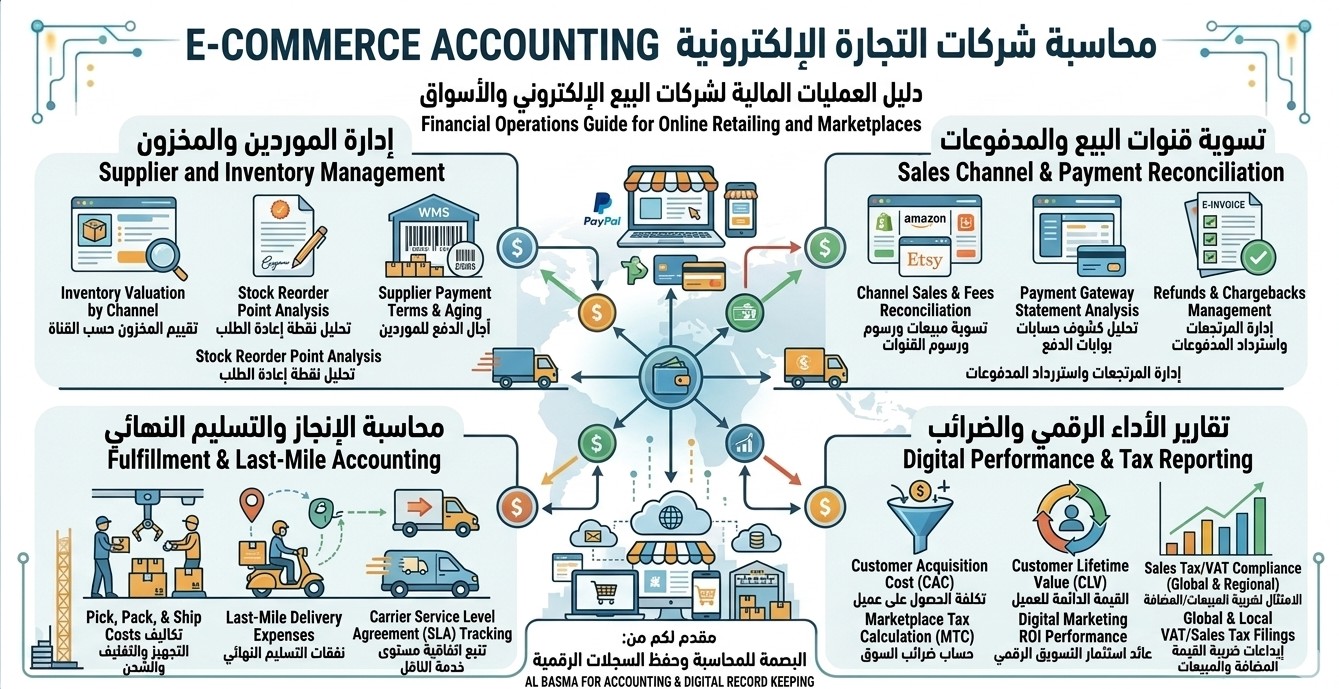
E-commerce accounting is not only about recording sales from a website or bank statement. An online store may sell through its own website, marketplaces such as Amazon or Noon, social media, payment gateways, cash on delivery, delivery companies, or external warehouses.

The practical issue is that the bank usually shows the net amount received after deducting marketplace commissions, payment gateway fees, delivery charges, refunds, or returns. Correct accounting should start from gross sales, then separate commissions, fees, returns, VAT, and inventory cost.

Al Basma helps e-commerce businesses organize accounts, match orders with collections, track inventory, review VAT, prepare Corporate Tax files, and produce clear reports on sales and profitability.

In e-commerce, bank receipts are not the real sales figure. Orders, invoices, marketplaces, payment gateways, shipping, and returns should all be reconciled.

Why Does E-Commerce Need Specialized Accounting?

E-commerce includes details that do not usually appear in traditional accounting. An order may be placed on the website, paid through a payment gateway, delivered by a courier, returned after a few days, settled through a marketplace, and finally transferred to the bank after deducting several fees.

If the company records only the net amount received in the bank as sales, important figures may disappear, such as gross sales, VAT, payment gateway fees, marketplace commissions, shipping costs, discounts, returns, and cost of goods sold.

For this reason, the online store needs a clear process connecting orders, invoices, collections, inventory, returns, and expenses, so that profit is based on the real business activity and not only on bank movement.

The common mistake in online stores is recording only the net bank settlement. The correct approach is to record gross orders first, then separate fees, commissions, and returns.

Types of E-Commerce Businesses We Serve

Own Online Stores

Organizing sales from Shopify, WooCommerce, or any independent online store and linking orders with payments and inventory.

Marketplace Sales

Tracking marketplace sales, commissions, storage or shipping fees, settlements, returns, and net bank transfers.

Social Media Sales

Organizing orders received from Instagram, TikTok, WhatsApp, or Facebook and linking them with collections, shipping, and invoices.

Payment Gateways

Reconciling payment gateway reports with orders, banks, fees, VAT, refunds, and customer repayments.

Cash on Delivery

Tracking amounts collected by delivery companies, courier fees, returns, pending balances, and collection differences.

Digital Services

Reviewing subscriptions, courses, software, digital files, electronic services, and the location of the customer or beneficiary.

Gross Sales or Net Settlement?

The most important point in e-commerce accounting is the difference between gross sales and net settlement. The store may sell a product for a certain amount, while the bank receives a lower amount after deducting marketplace commission, payment gateway fees, shipping costs, refunds, or returns.

Recording only the net settlement may understate sales, hide actual expenses, and affect VAT or Corporate Tax calculations.

  • Gross order value before deducting fees.
  • VAT or tax shown on the invoice, where applicable.
  • Payment gateway or bank fees.
  • Marketplace commission or platform fees.
  • Shipping or delivery charges.
  • Discounts and coupon codes.
  • Returns and refunds to customers.
  • Net amount transferred to the bank.

Correct accounting starts from the original order, not from the net bank transfer.

Payment Gateways and Bank Reconciliations

Payment gateways issue detailed reports showing orders, fees, pending amounts, transfers, refunds, and customer repayments. These reports should be reconciled with the online store and the bank statement.

A bank statement may show one combined transfer covering many orders. Therefore, the transfer should not be recorded as one sale without checking the payment gateway report and the related orders.

  • Matching each order with its payment transaction.
  • Reconciling payment gateway reports with bank statements.
  • Recording payment gateway fees as a separate expense.
  • Following up pending or unsettled amounts.
  • Recording refunds correctly.
  • Reconciling VAT and fees with detailed reports.

Cash on Delivery and Courier Companies

In cash on delivery, the amount does not enter the bank immediately at the time of sale. The courier company may collect from the customer, deduct delivery fees, return charges, or failed delivery costs, then transfer a net amount later.

For this reason, the courier company should be treated as a separate account. The company should know what was collected, what is pending, what was returned, and what was deducted as service fees.

  • COD orders by delivery company.
  • Amounts collected from customers.
  • Amounts not collected or rejected.
  • Returns and failed deliveries.
  • Delivery and collection fees.
  • Net transfers from courier companies to the bank.
  • Reconciliation of courier company balances with their reports.

Marketplace Sales

When selling through a marketplace, it is important to identify whether the platform is selling in its own name, acting as an intermediary, or only providing listing, collection, and delivery services. This affects how sales, commissions, and VAT are recorded.

Marketplaces usually provide settlement reports showing sales, commissions, storage or delivery fees, returns, discounts, and the final amount transferred. Each item should be recorded in the correct account.

  • Marketplace sales report.
  • Settlement and bank transfer report.
  • Marketplace commissions and service fees.
  • Shipping or storage fees, where applicable.
  • Returns, discounts, and credit notes.
  • Matching marketplace stock with company inventory.
  • Identifying whether the sale is in the company’s name or the platform’s name based on documents.

Inventory and Cost of Sales in E-Commerce

Inventory in e-commerce requires careful tracking, especially where the business sells through more than one channel: website, marketplace, branch, warehouse, or courier fulfilment provider. Any inventory error affects cost of sales and profit.

Each order should be linked to the item sold and its cost, and returns, damaged goods, replacements, and transfers between warehouses or platforms should be recorded correctly.

  • Inventory balance by item, warehouse, or platform.
  • Cost of goods sold for each order or period.
  • Matching sales with inventory movement.
  • Recording returns and adding them back to stock when accepted.
  • Monitoring damaged or unsellable goods.
  • Tracking inventory held by fulfilment companies or external platforms.
  • Profit margin report by item or sales channel.

Returns, Replacements, and Refunds

Returns are among the most important items affecting e-commerce accounts. A product may be returned after the sale, replaced, partially refunded, or exchanged for a coupon instead of cash.

The return should be recorded in a way that links it to the original order, invoice, inventory, refund amount, non-refundable fees, and any credit note required.

  • Original order number and original invoice.
  • Reason for return or replacement.
  • Returned product value and VAT amount, where applicable.
  • Whether the customer received a cash refund or a coupon.
  • Whether the product returned to inventory or became damaged.
  • Non-refundable shipping or payment fees.
  • Credit note or accounting adjustment required.

VAT in E-Commerce

VAT in e-commerce needs careful review because sales may be inside the UAE, outside the UAE, through a marketplace, through a private website, or related to electronic services or digital products.

The company should review whether sales are taxable, whether there are exports or services to customers outside the UAE, whether proper tax invoices were issued, and whether returns and credit notes were recorded in the correct tax period.

Online stores should also monitor the value of taxable supplies and imports to determine their VAT registration position, especially when sales grow quickly or when products or digital services are imported from outside the UAE.

Customer and Delivery Location

We review the customer location, delivery location, or place of use of the service to determine the correct treatment based on the supply type.

Tax Invoices

We review whether invoices issued by the store or platform contain the required details and are linked to orders and returns.

Returns and Credit Notes

We review returns, refunds, credit notes, coupons, and their effect on VAT and sales.

Corporate Tax for E-Commerce Businesses

Corporate Tax for e-commerce depends on correct profit. This profit cannot be identified unless gross sales, cost of goods, shipping, commissions, payment fees, advertising, returns, salaries, and operating expenses are recorded properly.

Many online stores achieve high sales but do not know their real profit because of advertising costs, marketplace commissions, returns, and shipping costs. Profitability reports by channel or product should therefore be prepared before Corporate Tax filing.

Related party transactions should also be reviewed, such as a related marketing company, warehouse owned by the business owner, or technical services between related companies.

Marketing and Advertising Expenses

Advertising is one of the largest expenses for online stores and may be paid to platforms inside or outside the UAE. Advertising expenses should be recorded by platform, campaign, and period, and connected with sales where possible.

The business should also review tax invoices or overseas platform invoices and consider the VAT impact of imported services or foreign charges, depending on the case.

  • Google, Meta, TikTok, and other platform ads.
  • Influencer and affiliate commissions.
  • Product photography, design, and content costs.
  • Store management or campaign management fees.
  • Application, tool, and platform subscriptions.
  • Advertising cost compared with sales report.

Documents and Reports We Need

  • Order report from the online store.
  • Sales reports from marketplaces.
  • Payment gateway and bank transfer reports.
  • Courier and cash on delivery statements.
  • Sales invoices and tax invoices.
  • Returns, refunds, and replacement reports.
  • Inventory and item movement reports.
  • Supplier invoices and cost of goods documents.
  • Shipping, storage, and packaging invoices.
  • Advertising, marketing, and subscription invoices.
  • Bank statements.
  • Previous VAT returns and Corporate Tax file.

Steps to Organize Online Store Accounts

  • Identify sales channels: website, marketplace, social media, or POS.
  • Link orders with invoices, payment gateways, and collections.
  • Record gross sales, not only net transfers.
  • Separate marketplace commissions, payment gateway fees, and shipping costs.
  • Track cash on delivery with courier companies.
  • Link each order with inventory movement and cost of goods.
  • Record returns, refunds, and credit notes.
  • Reconcile banks with payment gateways, marketplaces, and couriers.
  • Review VAT based on supply type and customer or delivery location.
  • Review marketing, advertising, and subscription expenses.
  • Prepare margin reports by product or channel.
  • Prepare Corporate Tax file and financial reports.

Common Mistakes in E-Commerce Accounting

  • Recording net bank transfers as sales only.
  • Not reconciling orders with payment gateways or marketplaces.
  • Hiding platform commissions and payment fees inside net settlements.
  • Not tracking cash on delivery with courier companies.
  • Not recording returns and refunds correctly.
  • Not linking sales with inventory and cost of goods.
  • Ignoring shipping, packaging, and storage costs.
  • Not reviewing VAT for sales outside the UAE or through marketplaces.
  • Not issuing or retaining proper tax invoices.
  • Not reviewing imported services such as ads and subscriptions.
  • Not preparing profitability reports by product or sales channel.
  • Filing VAT or Corporate Tax returns without a clear supporting document file.

The biggest risk in online store accounting is relying only on the bank. The bank shows what was received, but it does not show gross sales, returns, fees, or cost of goods.

Financial Reports Needed by an Online Store

  • Sales report by channel or marketplace.
  • Sales report by product or category.
  • Gross sales and net settlement report.
  • Payment gateway and marketplace fee report.
  • Cash on delivery and courier company report.
  • Returns and refunds report.
  • Inventory and cost of goods sold report.
  • Profit margin report by product or channel.
  • Advertising and marketing cost compared with sales.
  • VAT and Corporate Tax report.

Who Needs This Service?

  • Online stores operating in the UAE.
  • Sellers on Amazon, Noon, or similar marketplaces.
  • Stores using Shopify or WooCommerce.
  • Businesses selling through Instagram, TikTok, or WhatsApp.
  • Companies relying on cash on delivery.
  • Online stores with frequent returns or multiple delivery providers.
  • Companies with inventory that does not match sales.
  • Stores that do not know real profit by product.
  • Companies preparing for VAT registration or VAT filing.
  • Companies preparing for Corporate Tax filing or audit.

How Can Al Basma Help with E-Commerce Accounting?

Al Basma organizes online store accounts by connecting orders, invoices, payment gateways, marketplaces, courier companies, inventory, and expenses in one clear accounting process.

We help reconcile sales with collections, separate commissions and fees, track cash on delivery, record returns, review VAT, and calculate cost of goods sold.

We also prepare periodic reports showing sales, net settlement, profit margin, inventory, advertising costs, VAT, and Corporate Tax so management can make better pricing and marketing decisions.

Services Related to E-Commerce Accounting

Why Choose Al Basma for Your Online Store Accounts?

  • Reconcile sales with payment gateways, marketplaces, and banks.
  • Record gross sales instead of net transfers only.
  • Track cash on delivery and courier company balances.
  • Organize inventory and cost of goods sold.
  • Review returns, refunds, and credit notes.
  • Prepare VAT, Corporate Tax, and financial reporting files.

Important Notice: The information provided on this page is intended for general informational purposes only and does not constitute legal, tax, accounting, or professional advice. It should not be relied upon as a substitute for reviewing the applicable laws, regulations, decisions, and official guidance issued by the competent authorities in the United Arab Emirates.

The appropriate legal, tax, or accounting treatment may vary depending on the specific facts and circumstances of each case.

If you require professional advice or assistance relating to your particular situation, please contact us and our team will be pleased to review your case and provide appropriate support.


Related Updates and Articles

site menu

Al Basma Accounting & Bookkeeping provides accounting, audit, taxation, financial advisory, expert reporting, and company formation services in the United Arab Emirates.
Al Basma is also an FTA Approved Tax Agency providing VAT, Corporate Tax, and Tax Compliance services in accordance with UAE tax regulations.

Our Services

```
Al Basma Services

Contacts

Call  +971506861518

Whatsapp: 00971525886295

EMAIL : info@albasmaa.com

Financial Solutions


Corporate Tax

To Know our Services, Don't wait call us or leave your Number in online Chat with time you can received our call and we will call you back or send Email to info@albasmaa.com  now.

For join for our team please to send C.V. for Waleed@albasmaa.com